When the Dangote Refinery began ramping up petrol production, it arrived
wrapped in a promise that mattered enormously to a country still reeling from
the 2023 removal of fuel subsidies: that local refining, at scale, would
finally break Nigeria's decades-long dependence on imported petroleum products
and, with it, ease the price pressure that had pushed petrol from roughly ₦185
per litre to well over ₦500 almost overnight when the subsidy came off. Three
years into that transition, with a fresh price hike sweeping through the market
in mid-July 2026, the honest answer to whether that promise has been kept is:
partially, unevenly, and not yet enough to insulate Nigerians from the shocks
that keep arriving from the import-dependent side of the market.
The Case for Progress
The clearest evidence of the refinery's effect shows up at the pump in Lagos
and its surrounding states. As of early July 2026, stations supplied directly
under the refinery's pricing were selling petrol at approximately ₦1,075 per
litre, a figure that recent reductions in the refinery's ex-depot price had
helped bring down, compared to ₦1,100 to ₦1,400 at many independent stations
relying on imported cargoes. That gap — sometimes ₦200 or more per litre —
represents real, measurable savings for motorists who know which stations draw
from Dangote supply, and it has visibly reshaped competitive dynamics among
marketers in the South-West, several of whom have had to adjust their own
pricing downward to remain competitive with refinery-linked stations nearby.
This dynamic reflects exactly what the refinery's backers argued it would
deliver: a domestic supply source large enough to put competitive pressure on
import-dependent pricing, gradually pulling the broader market toward lower
numbers as more stations gain access to Dangote-refined product rather than
relying on the more expensive, exchange-rate-sensitive alternative of shipping
in refined fuel from abroad.
Where the Promise Runs Into Reality
But the mid-July price hike is a reminder of how much of the Nigerian fuel
market still sits outside the refinery's direct reach. The increase that pushed
depot prices from ₦1,230 to ₦1,350 per litre, with pump prices expected to
follow toward ₦1,380 to ₦1,400, was driven by importers responding to the
rising cost of imported fuel cargoes — a cost structure entirely separate from
the Dangote Refinery's domestic production economics. In other words, even as
the refinery's own gantry price held steady or fell, a large share of the
market moved upward anyway, because import-dependent marketers still supply a
substantial portion of the country's fuel, particularly outside the refinery's
strongest distribution radius around Lagos.
This split market — one segment tracking the refinery's increasingly
competitive domestic pricing, another still tethered to the naira's exchange
rate and global crude costs through imports — means the refinery's benefits
have not yet reached every Nigerian motorist equally. States further from
Lagos, where the refinery's logistical advantage weakens and import-supplied
stations dominate, have continued to see prices climb largely independent of
whatever relief Dangote's output provides closer to its Lekki base.
The Regulatory Dimension
The Nigerian Midstream and Downstream Petroleum Regulatory Authority has
continued to play a balancing role in this transition, issuing fresh fuel
import licenses for the third quarter of 2026 even as the refinery's output grows
— a decision that reflects an official strategy of maintaining import capacity
as insurance against any disruption to domestic supply, rather than allowing
the market to consolidate entirely around a single refining source. That
approach has obvious risk-management logic behind it: an economy of Nigeria's
size cannot responsibly depend on one refinery, however large, without a backup
import channel. But it also means the price-suppressing effect of domestic
refining will likely remain partial for the foreseeable future, coexisting with
— rather than fully replacing — the import market and its exposure to global
price swings.
A Marketer's Perspective
Independent fuel marketers, who occupy the middle ground between refiners and
the pump, describe living inside this tension every week. One marketer
operating several stations in Ogun State, discussing how he sets his pricing,
explained that he adjusts his numbers almost daily based on which supplier he's
currently drawing from — Dangote-linked product on some days, imported cargo on
others, depending on availability and cost at the moment he needs to restock.
That variability, he said, makes it difficult for him to offer customers the
kind of price stability that would let them plan around a predictable fuel
budget, even in a period when the underlying trend for domestically refined
product has generally moved downward.
What Comes Next
The trajectory suggests a market in transition rather than one that has arrived
at its destination. As the Dangote Refinery continues to expand its output and,
potentially, its distribution network beyond its current strongest radius
around Lagos, the price-suppressing effect it has already demonstrated in the
South-West could plausibly extend further into the country over time, gradually
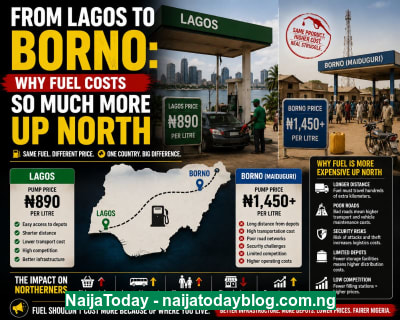
narrowing the regional gaps that currently leave states like Kano, Kaduna, and
Borno paying substantially more than Lagos and Rivers.
But that extension is not automatic, and it is not instantaneous. It depends on
infrastructure — new pipelines, storage depots, and distribution partnerships —
reaching regions that currently depend on longer, costlier supply chains built
around imported product. Until that infrastructure catches up with the
refinery's production capacity, Nigeria's fuel market will likely continue to
behave the way it has this July: showing genuine, measurable progress in the
areas closest to domestic refining, while remaining fully exposed to global
price shocks everywhere else.
For now, the honest verdict on the Dangote Refinery's promise is neither the
triumphant story its most optimistic backers predicted, nor the empty one its
skeptics feared. It is a story still being written — one where a Lagos motorist
filling up at a Dangote-linked station genuinely pays less than he would have
without the refinery's existence, even as a driver in Kano or Maiduguri,
watching the same week's price hike arrive at his local station regardless,
waits to see when, or whether, that same relief eventually reaches him.
💼 Business🔥 HOT
Dangote Refinery's Promise: Has It Really Lowered Pump Prices?
By NaijaToday Desk · 18 July 2026 · 6 min · 👁 7
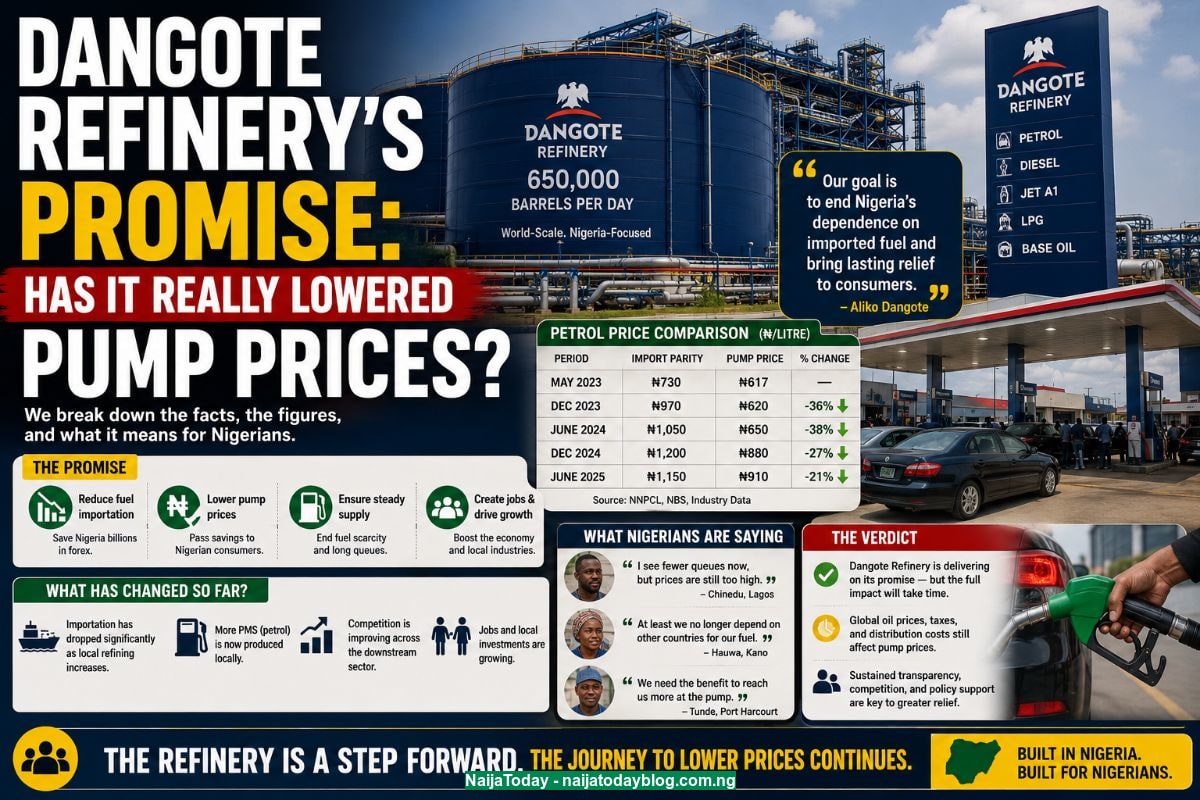
An honest assessment of how much the Dangote Refinery has actually brought petrol prices down, and where its impact still falls short. Category: Energy & Industry
#dangote refinery#local refining#petrol import#nmdpra#ex-depot price#energy policy#downstream sector
How does this story make you feel?
No account or sign-in needed. You can react instantly.
Share:
NaijaToday Desk
The NaijaToday newsroom
More Stories to Explore
More reporting selected from NaijaToday, based on topics and categories.