How Nigerians
Can Build a Steady Online Income in 2026: A Practical Guide to Freelancing,
Content Creation, and AI Tools
For millions of Nigerians, the naira's unpredictable purchasing power and a
tight formal job market have made "side income" less of a luxury and
more of a survival strategy. The good news is that 2026 offers more legitimate
ways than ever to earn from a laptop or even a smartphone — if you know where
to look and how to avoid the scams that flood social media timelines. This
guide breaks down realistic paths to online income, what tools are worth your
time, and the mistakes that trip up most beginners.
Why Online Income Has Become a Necessity, Not a Hobby
Inflation has eaten into salaries across almost every sector, and even
well-paying jobs in Lagos or Abuja often no longer stretch to cover rent,
transport, and food comfortably. At the same time, global companies are more
willing than ever to hire remote talent from Nigeria for tasks that don't
require a physical office — writing, design, virtual assistance, customer
support, and increasingly, AI-assisted work. The shift isn't temporary; it
reflects a broader move toward distributed, skills-based hiring that rewards
output over location.
Path 1: Freelancing on Global Platforms
Freelancing remains the most dependable entry point because it pays in dollars
or other stable currencies, which cushions against naira depreciation.
Where to start:
- Upwork and Fiverr remain the biggest marketplaces for writing, graphic
design, video editing, and virtual assistance work. Competition is high, so a
focused niche (e.g., "SEO blog posts for fintech startups" rather
than "any kind of writing") gets noticed faster.
- Contra and PeoplePerHour are smaller but less saturated, which can mean
quicker first jobs for newcomers.
- LinkedIn is underused by many Nigerian freelancers but is where a lot of
serious, higher-paying clients look for talent — a well-optimized profile and
consistent posting can bring inbound inquiries without bidding wars.
Getting paid: Payoneer and Wise are the two most reliable ways to receive
international payments and convert them to naira without excessive fees. Avoid
platforms that insist on unconventional payment methods — that's a common
scam signal.
Path 2: Content Creation
Content creation has matured well beyond "just post consistently."
What separates creators earning real money from those stuck at a few hundred
followers is a clear niche and a monetization plan from day one.
Realistic income streams:
- YouTube and TikTok ad revenue through their respective monetization
programs, though payouts from Nigerian-based views are modest — brand deals
typically pay far more than platform ad revenue.
- Brand partnerships and affiliate marketing, where a creator promotes
products relevant to their niche (finance apps, skincare, gadgets) for a
commission or flat fee.
- Digital products — e-books, templates, or mini-courses sold via Selar,
Gumroad, or Paystack storefronts — which convert an existing audience into
direct income rather than relying on ad networks alone.
The mistake most beginners make is chasing every trending format instead of
building a recognizable niche. Audiences (and brands) pay for expertise and
consistency, not volume.
Path 3: AI-Powered Income Streams
This is the newest and fastest-growing lane, and one where Nigerians who move
early have a real advantage.
- AI-assisted content services: Offering blog writing, video scripts, or
social media content where AI tools speed up drafting, but human editing and
local context provide the actual value clients pay for.
- Prompt engineering and AI workflow setup: Small businesses increasingly
need help setting up chatbots, automating customer replies, or building simple
AI-powered tools — a skill gap many Nigerian freelancers are filling on
Upwork and Fiverr.
- Selling AI-generated digital assets (templates, design packs, structured
guides) where the AI speeds up production but the seller still needs to curate
and package it well to stand out.
The caveat: AI tools lower the barrier to entry for everyone, which means
differentiation — voice, niche expertise, and quality control — matters
more than ever, not less.
Common Pitfalls to Avoid
1. Get-rich-quick schemes disguised as "online business
opportunities" — if a program promises guaranteed daily payouts for
minimal work, treat it as a red flag.
2. Underpricing services to win the first few clients, then struggling to
raise rates later. It's better to start modestly but signal a clear rate
structure from day one.
3. Ignoring taxes and business structure — as online income grows,
registering a business name (via CAC) and keeping basic records makes it easier
to open business bank accounts and access loans or grants later.
4. Platform dependency — relying entirely on one platform (a single
YouTube channel, one client) is risky. Diversifying income sources protects
against sudden policy or algorithm changes.
Getting Started This Week
- Pick one path (freelancing, content, or AI services) rather than trying all
three at once.
- Set up a Payoneer or Wise account if you don't already have one, since
payment friction is one of the biggest early blockers.
- Build a simple portfolio — even three to five sample pieces of work —
before pitching or posting publicly.
- Give yourself a 90-day window to test the approach before judging whether
it's working.
Online income in Nigeria isn't a shortcut, but for those willing to treat it
like a real skill-building process, 2026 offers more legitimate doors than at
almost any point before.
---
This piece is part of NaijaToday's ongoing coverage of jobs, business, and
financial resilience for Nigerians. Have a personal story about building online
income? Share it with us.
💼 Business🔥 HOT
How Nigerians Can Build a Steady Online Income in 2026: A Practical Guide to Freelancing, Content Creation, and AI Tools
By NaijaToday Desk · 2 August 2026 · 5 min · 👁 12
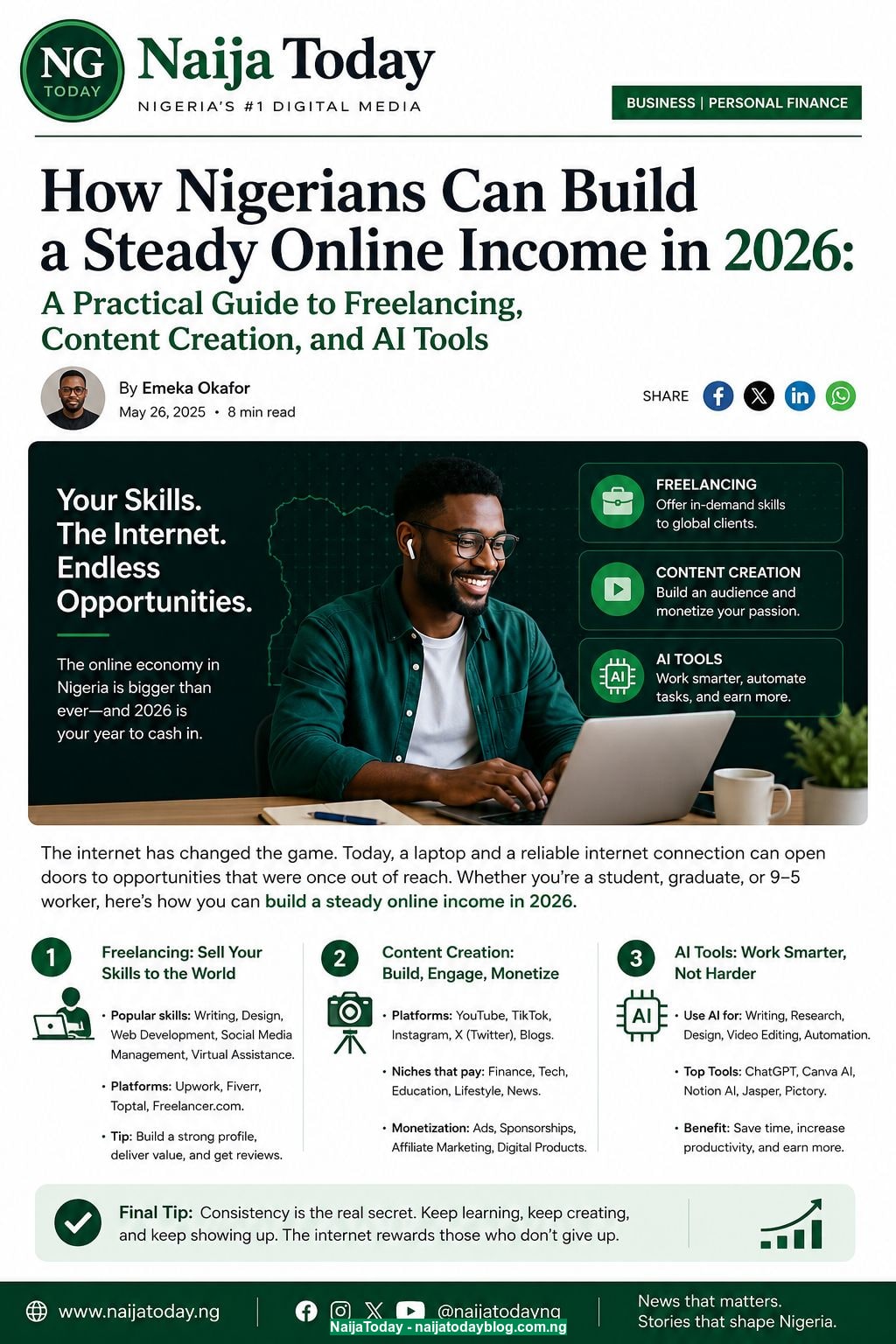
A 2026 guide for Nigerians looking to earn online through freelancing, content creation, and AI-powered tools — practical steps, platforms, and pitfalls to avoid.
How does this story make you feel?
No account or sign-in needed. You can react instantly.
Share:
NaijaToday Desk
The NaijaToday newsroom
More Stories to Explore
More reporting selected from NaijaToday, based on topics and categories.