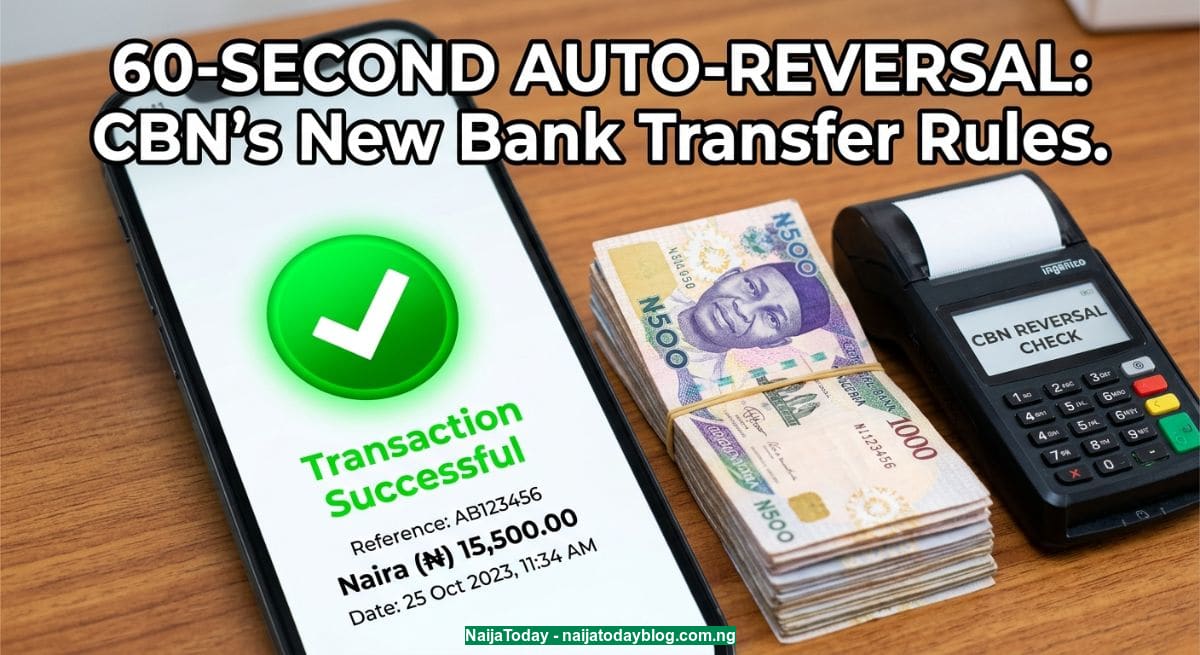
The Everyday Nightmare of
Nigerian Digital Payments
If you have ever stood at a busy PoS kiosk on a
hot Friday afternoon in Lagos, watching an impatient merchant shake their head
while your bank app confirms that your account was debited, you already know
the specific kind of anxiety that has defined Nigerian digital payments for
over a decade.
The scenario is painfully familiar: You
transfer ₦25,000 for weekend groceries or fuel. The merchant’s terminal prints
a paper slip bearing the words 'Transaction Failed.' Almost simultaneously,
your phone buzzes with a debit alert from your commercial bank. The merchant
refuses to release the goods without a physical receipt or a successful credit
alert. You end up paying a second time in cash or through an alternative app,
leaving you out of pocket.
What follows is an exhausting odyssey: filling
out digital dispute resolution forms, visiting crowded bank branches, arguing
with customer service representatives who sound just as drained as you are, and
waiting anywhere from three to fourteen business days for your own money to be
reconciled and returned.
That era of systemic inefficiency, customer
helplessness, and institutional indifference is officially coming to a
mandatory end.
With the full implementation of the National
Open Banking API Framework, the Central Bank of Nigeria (CBN) has delivered its
clearest, most aggressive regulatory directive yet regarding interbank
transaction settlement speeds, system interoperability, and dispute resolution
protocols. At the core of this monumental regulatory shift is a single,
non-negotiable metric: any retail electronic bank transfer that fails to
complete must automatically reverse back into the sender's available balance
within 60 seconds, or the defaulting financial institution will face automatic
per-minute penalty billing deducted directly from its clearing account with the
central regulator.
[ Customer Initiates Transfer via Mobile App /
PoS ]
│
▼
[ Universal Open Banking API Gateway (Standardized Protocols) ]
│
┌────────────────┴────────────────┐
▼ ▼
[ Primary Route Clear ] [ Network
Delay / Switch Timeout ]
│ │
▼ ▼
[ Instant Recipient Credit ] [
AUTO-REVERSAL TRIGGERED AT SWITCH ]
(5-Second Settlement)
│
▼
[ System
Audits Failed Ledger ]
│
▼
[ Funds
Restored to Sender's Account ]
(Within
60 Seconds - 0 Manual Intervention)
The Architecture of Failure: Why
Transfers Kept Breaking Down
To understand why this regulatory intervention
is revolutionary, one must look under the hood of Nigeria’s legacy banking
infrastructure. Over the past decade, Nigeria made astonishing leaps in
financial inclusion and digital payment adoption. Driven by central bank
cashless policies, cash shortages, and a vibrant startup ecosystem, millions of
citizens transitioned from physical notes to mobile transfers.
However, the underlying technology
infrastructure did not evolve at the same pace across all players in the
ecosystem.
Historically, Nigeria's digital payment
ecosystem operated on a multi-layered, fragmented relay model. When you sent
money from a traditional commercial bank to another bank or fintech wallet,
your request traversed several distinct technology nodes: legacy core banking
systems, central switches, and destination APIs.
Under the old legacy architecture, if any
single link in this chain experienced network congestion, server latency, or
database timeout, the payment message broke. The sending bank’s ledger recorded
a debit, while the receiving bank recorded a timeout. Because institutions did
not share real-time, bi-directional database access, funds were trapped in
intermediate clearing escrow accounts.
Inside the Open Banking API
Framework
The CBN’s newly enforced Open Banking Framework
solves this systemic problem by establishing a single, standardized tech
language across all licensed financial operators in the Federal Republic of
Nigeria.
·
Universal
Data Standards: All banks, payment service banks (PSBs), microfinance
institutions, and mobile wallets must expose uniform, secure endpoints for
account validation, balance checks, transaction posting, and settlement
confirmation.
·
Bi-Directional
Real-Time Visibility: Under the Open API standard, when Bank A routes a
transfer to Fintech B, Bank A can instantly inspect the status of the
destination ledger in milliseconds.
·
Switch-Level
Auto-Reversal Triggers: If a transaction confirmation handshake fails to return
a positive status within 60 seconds, the central switch infrastructure
automatically invalidates the transaction ticket and forces the sending bank to
instantly un-hold the customer’s funds.
·
Mandatory
Uptime SLA Tracking: Financial institutions are now rated on real-time public
dashboards. Any institution whose API success rate falls below 99.9% faces
immediate structural restrictions.
The Economic Impact on Small
Businesses and Informal Commerce
Micro, Small, and Medium Enterprises (MSMEs)
form the structural backbone of Nigeria’s GDP, accounting for over 80% of total
employment. From open-market traders in Balogun, Ariaria, and Kano’s Kurmi
market to ride-hailing drivers, street food vendors, and corner chemists, daily
commerce relies heavily on immediate cash liquidity and fast payment
confirmation.
With the enforcement of the 60-second
auto-reversal standard and instantaneous cross-platform credit alerts, friction
is removed from daily trade. Merchants can accept payments from any bank or
fintech app with complete confidence. The fear of 'debit without alert' is
removed, encouraging hesitant cash-preferred citizens to embrace digital
financial services.