How to Start a
Business in Nigeria in 2026 With Little Capital — Complete Step-by-Step
Guide
Nigeria's entrepreneurial landscape is experiencing an unprecedented surge.
From tech hubs in Yaba, Lagos to bustling trade centres in Onitsha and Aba,
more Nigerians than ever are transitioning from employees to business owners.
The question is no longer whether to start a business — the question is how to
start the right one, the right way, with limited capital.
This guide is for anyone who wants to start a business in Nigeria in 2026 —
whether you are a recent graduate, a civil servant looking to create a
secondary income, or someone who wants to finally turn a business idea into
reality. We cover everything from finding the right idea to CAC registration,
banking, funding, and scaling.
### Step 1: Develop and Validate Your Business Idea
Before spending a single naira, you need to be sure your idea can actually
generate income. Many Nigerians start businesses based on what they think will
work, without checking whether people are actually willing to pay for it.
Start by asking three questions: What problem does my product or service solve?
Who specifically will pay for it, and how often? Is there already demand for
this, or am I creating demand from scratch?
The best business ideas for Nigeria in 2026 combine what you are already good
at with what people are actively seeking. Understanding the 2026 Nigerian
consumer is important — today's buyer is price-conscious but values
convenience, speed, and quality. Digital transformation means even traditional
businesses need an online component to compete.
**Low-capital business ideas with proven demand in Nigeria right now:**
Food and snacks business — packaging soups, chin-chin, puff puff, or office
lunch deliveries. Startup cost as low as ₦20,000 to ₦70,000. POS agent services
— high demand everywhere, especially in densely populated areas. Freelancing —
writing, design, video editing, social media management. VTU reselling — data
and airtime sales with minimal capital. Mini importation — sourcing trending
items from platforms like Alibaba or 1688 and reselling locally. Profit margins
of two to three times the purchase price are common. Online retail — selling
clothing, accessories, beauty products, or electronics through Instagram,
WhatsApp, Jumia, and Konga. Graphic design and printing services — flyers,
business cards, banners, and branded materials are needed by almost every
business. Cleaning and laundry services — consistently high demand in urban
areas.
### Step 2: Conduct Market Research
Once you have a business idea you are excited about, spend at least two weeks
validating it in the real world before investing any money.
Talk to at least ten potential customers. Ask them whether they would pay for
your product or service, how much they would pay, and what alternatives they
are currently using. Join Facebook groups and WhatsApp communities related to
your industry and observe the conversations. What problems are people
complaining about? What are they asking for? Look at what competitors are
doing. Study their pricing, marketing, and what customers say about them in
reviews and comments.
The goal of market research is not to find a reason not to start. It is to
refine your idea so that when you do start, you have a much higher chance of
success.
Step 3: Write a Simple Business Plan
A business plan does not need to be a fifty-page document. For a small startup,
a simple one-page plan covering the following is enough: What exactly will you
sell? Who are your target customers? How will you reach them? What will your
startup costs be? What are your projected monthly revenue and expenses? How
long before the business becomes profitable?
Writing this down forces you to think clearly about your numbers and your
strategy. It also becomes essential when you approach banks, investors, or
government funding schemes.
Step 4: Register Your Business with CAC
You cannot legally operate a business in Nigeria without registering with the
Corporate Affairs Commission (CAC). Registration gives your business
credibility, protects your business name from being used by others, and is
required to open a corporate bank account.
In 2026, the CAC registration process is primarily digital through the CAC
post-incorporation portal at post.cac.gov.ng. You will need your National
Identification Number (NIN), a valid government-issued ID, and your preferred
business name.
Important 2026 Update: As of January 1, 2026, your CAC registration number
(RC number) automatically serves as your Tax Identification Number (TIN). You
no longer need to file a separate application with the Federal Inland Revenue
Service (FIRS) for basic tax purposes — one registration covers both.
There are two main registration types for small businesses: Business Name
registration, which is ideal for sole proprietors and small startups; and
Limited Liability Company (LTD) registration, which is recommended if you plan
to scale, hire employees, or seek external investment.
Business Name registration typically costs between ₦10,000 and ₦25,000
including all government fees and a search fee. An LTD registration costs more
but provides stronger legal protection.
As soon as your CAC name is approved, also secure your domain name (a .com or
.ng domain) to protect your brand online.
Step 5: Open a Corporate Bank Account
After registration, open a dedicated business bank account separate from your
personal account. This is one of the most important disciplines for any
business owner. Mixing personal and business finances is a recipe for confusion
and financial trouble.
Choose a bank with strong digital banking tools, low transaction fees, and a
track record of supporting small businesses. Get your business debit card,
activate mobile and internet banking, and set up standing instructions or
auto-saves if possible.
Also set up a professional business email address — something like
info@yourbusinessname.com. Using a Gmail or Yahoo address for a business
significantly reduces your credibility with banks, partners, and clients.
Step 6: Build Your Online Presence
In 2026, every business needs to be findable online. Whether you sell physical
products or offer services, your potential customers are searching for
solutions on Google, Instagram, WhatsApp, and TikTok before making any buying
decision.
At minimum, every Nigerian business needs a WhatsApp Business account set up
with your business name, profile photo, opening hours, and a product catalogue.
An Instagram business page with consistent posts and a Facebook page for local
community presence are also essential.
If your budget allows, a simple website greatly increases your credibility and
helps you appear in Google search results. Platforms like WordPress, Wix, and
Hostinger make it possible to build a basic website for under ₦30,000 per
year.
Step 7: Secure Your Startup Capital
Capital is the lifeblood of any new business. If you do not have enough saved
personally, here are your options in 2026:
Personal savings: The safest option. Start small with what you have,
validate the business, and reinvest profits to grow.
Family and friends: The most accessible informal funding source for
Nigerian entrepreneurs. Be professional — document agreements in writing even
with family members.
Government and institutional funding: If you want the cheapest money
available, government schemes offer the lowest interest rates. The Bank of
Industry (BOI) provides loans up to ₦5 million at 9% interest for manufacturing
and agro-processing businesses. The SMEDAN–Sterling Bank partnership offers
funding between ₦500,000 and ₦2.5 million for small businesses with steady cash
flow. In 2026, the iDICE Fund — a $617 million fund — is actively targeting
tech and creative startups in Nigeria with both equity and debt capital.
Microfinance banks: Accessible short-term funding at higher interest rates
but with more flexible requirements than commercial banks.
Cooperatives: Many Nigerian workers belong to cooperatives that offer
members low-interest loans. If you are a member, this can be a valuable source
of startup capital.
Step 8: Launch, Market, and Grow
Many first-time entrepreneurs spend months perfecting their product or service
before launching. The better approach is to launch with what you have, gather
real customer feedback, and improve as you go. Done is better than perfect.
For marketing in 2026, your most powerful tools as a small Nigerian business
are WhatsApp status updates and broadcast lists for reaching your immediate
network; Instagram Reels and TikTok for reaching beyond your network
organically; word-of-mouth referrals, which remain the most trusted form of
marketing in Nigeria; and Google Business Profile, which makes your business
appear in local Google searches for free.
Consistency is everything. Businesses that post regularly, respond to inquiries
quickly, and treat every customer as a potential referral source are the ones
that grow. Nigerians talk — a great customer experience creates multiple
referrals; a bad one creates multiple complaints.
Final Words: Start Before You Feel Ready
Every major Nigerian business started small. The woman behind the popular
catering brand began selling rice from her kitchen. The logistics company that
now delivers thousands of packages daily started with a motorcycle and one
client. The digital agency with twenty employees was once a freelancer with a
laptop.
The difference between aspiring entrepreneurs and actual business owners is one
thing: the decision to start. The economic environment in Nigeria in 2026 is
challenging — but challenges create opportunities. There is demand all around
you, waiting for someone willing to show up consistently and solve a
problem.
Pick one idea. Validate it this week. Register your business next week. Get
your first customer within thirty days. Build from there.
Your Nigerian success story starts with the next step you take.
💼 Business🔥 HOT
How to Start a Business in Nigeria in 2026 With Little Capital — Complete Step-by-Step Guide
By NaijaToday Desk · 29 June 2026 · 5 min · 👁 4
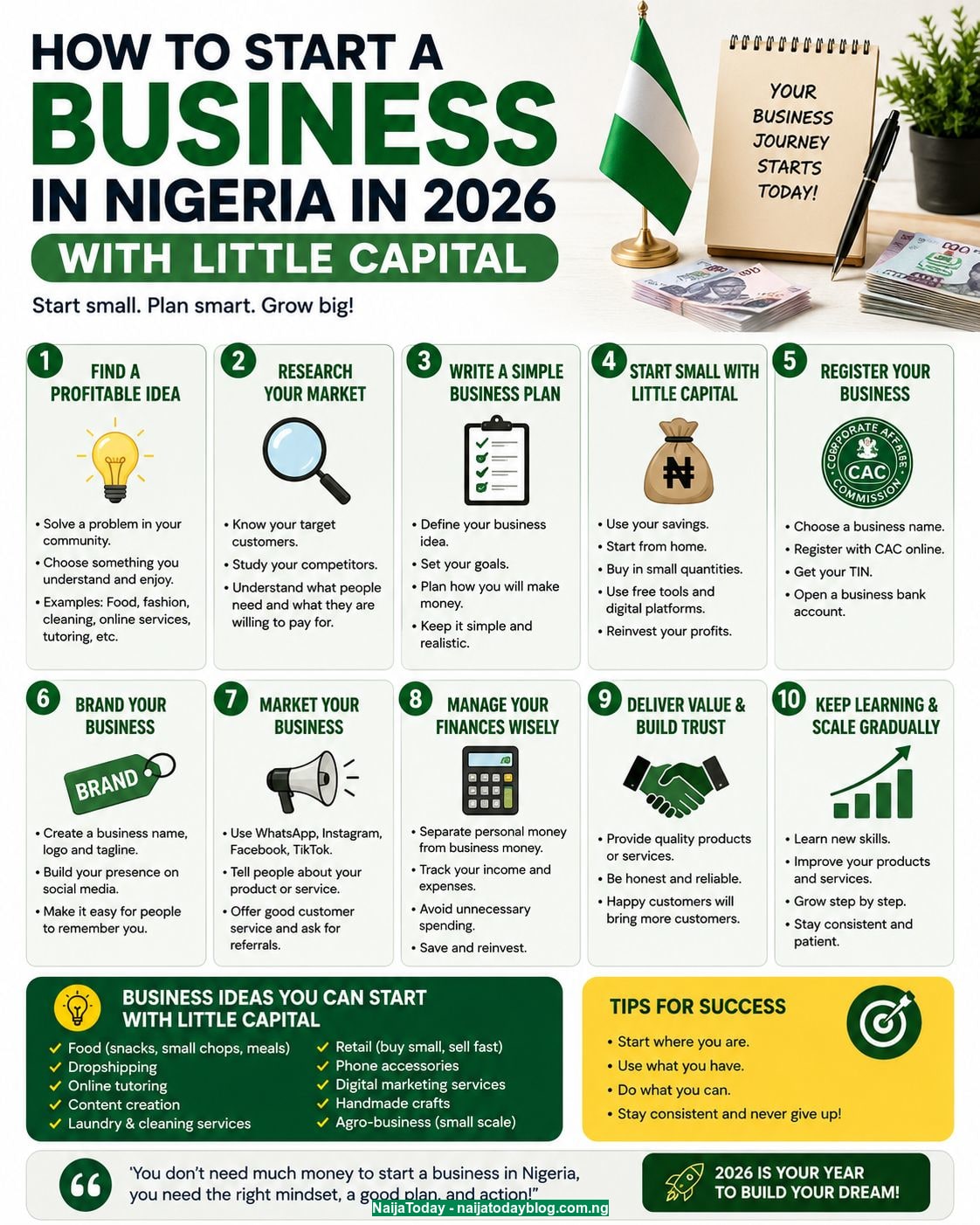
Want to start a business in Nigeria in 2026 but don't have much money? This step-by-step guide covers the best low-capital business ideas, how to register with CAC, how to fund your business, and how to grow it.
#how to start a business in nigeria#business ideas nigeria 2026#small business nigeria#cac registration nigeria#low capital business nigeria#profitable business ideas nigeria#how to register business nigeria#entrepreneur nigeria 2026#start up nigeria
How does this story make you feel?
No account or sign-in needed. You can react instantly.
Share:
NaijaToday Desk
The NaijaToday newsroom
More Stories to Explore
More reporting selected from NaijaToday, based on topics and categories.