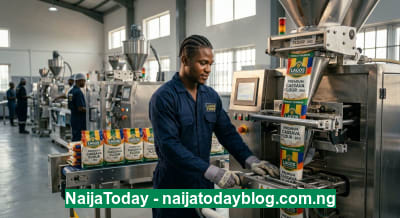
When the Dangote
Petroleum Refinery finally began processing crude oil at meaningful scale, the
reaction from Nigerians was a mixture of pride, relief, and cautious
expectation. Here, at last, was the thing that was supposed to change
everything — a 650,000-barrel-per-day refinery sitting on the edge of the Lagos
lagoon, the largest single-train refinery in the world, built by a Nigerian for
Nigeria.
The promise was simple and powerful: Nigeria, which sits atop some of the
largest crude oil reserves in Africa, would no longer have to import the
refined petroleum products that its own people needed to cook, to drive, to run
generators, to power the engines of daily life. The foreign exchange
haemorrhage caused by petrol imports would stop. Pump prices would stabilise.
The naira would strengthen. Industry would have cheaper inputs. Life would get
better.
That was the promise. The question — the honest, difficult, necessary question
— is what has actually happened.
What the Refinery Has Achieved
Let us start with what is genuinely true and genuinely impressive.
The Dangote Refinery is operational. After years of delays, false starts,
funding crises, and the particular Nigerian tendency to announce completion
long before completion has actually arrived, the refinery is processing crude
oil and producing refined products at increasing scale.
In June 2026, reports confirmed that the refinery had increased its processing
capacity further — a development that economists and energy analysts described
as potentially significant for domestic fuel supply and industrial output. The
refinery has moved beyond symbolic production into something approaching
meaningful contribution to Nigeria's fuel supply.
This is not nothing. This is, in fact, considerable. The construction of this
refinery — financed largely by Aliko Dangote's personal wealth and a consortium
of international lenders — was an act of private-sector ambition at a scale
Nigeria has rarely seen. Whatever criticisms follow, that achievement deserves
to be acknowledged clearly.
The Foreign Exchange Question
One of the central promises of the Dangote Refinery was that it would reduce
Nigeria's dependence on imported petroleum products and thereby reduce the
pressure on the country's foreign exchange reserves.
Nigeria has historically spent billions of dollars importing petrol, diesel,
kerosene, and aviation fuel — products that its own refineries, if they
functioned, should have been producing domestically. The Port Harcourt, Warri,
and Kaduna refineries — collectively capable of refining 445,000 barrels per
day when built — have for decades operated at a fraction of their stated
capacity, victims of chronic underfunding, corruption, and institutional
neglect.
The foreign exchange cost of fuel imports has been a persistent drag on the
naira and a consistent source of instability in Nigeria's balance of payments.
If the Dangote Refinery can supply a significant portion of Nigeria's domestic
fuel needs, the import bill falls, foreign exchange demand eases, and the naira
has room to appreciate.
The evidence on this front is encouraging but not yet conclusive. The naira has
found greater stability in 2026 compared to the crisis years of 2023-2024, but
that stabilisation reflects multiple factors — including the CBN's tighter
monetary policy, improved oil revenues, and greater exchange rate flexibility —
not the refinery alone.
What is clear is that the direction of travel is the right one. Every barrel of
petroleum product produced domestically is a dollar not spent on imports. At
scale, that matters enormously.
The Pump Price Reality
Here is where the story becomes more complicated.
The removal of the petrol subsidy in May 2023 — announced on the day of
President Tinubu's inauguration — was presented in part as a reform that would
become more manageable once domestic refining capacity came online. The logic
was that a functioning domestic refinery would reduce the cost of producing
fuel for the Nigerian market, and that savings would eventually filter down to
consumers.
Pump prices have not fallen. They have, in fact, continued to fluctuate at
levels that are dramatically higher than what Nigerians paid before the subsidy
removal. The average Nigerian is spending a larger share of their income on
fuel than at any point in recent memory.
Several factors explain this. The refinery sells its products at international
market prices, not subsidised domestic prices. The distribution infrastructure
— the pipelines, the depots, the logistics chains — that would need to work
efficiently to bring products from Lekki to petrol stations across the country
has its own costs and inefficiencies. And the general cost environment in
Nigeria, shaped by inflation and the weaker naira, means that even domestically
produced fuel is not cheap to produce or distribute.
This is not a criticism of the refinery itself. A private refinery is not a
social welfare programme. But it is important that Nigerians understand the
distinction between the existence of domestic refining capacity and the
reduction of fuel costs at the pump. These are related but not identical
outcomes, and the timeline between them may be longer than was implied in the
initial excitement.
What It Means for Industry
Beyond the fuel price question, the Dangote Refinery's most significant
economic impact may be on Nigerian industry — specifically on businesses that
use petrochemical products as inputs.
The refinery is not just producing petrol and diesel. It is also producing
liquefied petroleum gas (LPG — cooking gas), aviation fuel, and petrochemical
feedstocks. Each of these products, if available domestically at competitive
prices, reduces costs for businesses that currently import them or pay the
premium of a fragmented domestic market.
For the aviation sector, domestic production of jet fuel is potentially
transformative. Nigerian airlines have been crippled for years by the
combination of high fuel costs, foreign exchange scarcity for importing fuel,
and the general unreliability of supply. If the refinery can supply aviation
fuel at scale and competitive prices, the cost structure of Nigerian aviation
changes.
For manufacturers, LPG pricing matters. For transport businesses, diesel
pricing matters. The refinery's eventual full-capacity operation creates
possibilities for cost reduction across multiple sectors of the economy —
possibilities that do not show up immediately in pump price headlines but that
will accumulate over time.
The Distribution Challenge Nigeria Is Not Talking About Enough
One aspect of the Dangote Refinery story that receives far less attention than
it deserves is the distribution problem.
Nigeria's pipeline infrastructure — the network of pipelines, storage depots,
and pumping stations that should move petroleum products from refineries to
retail outlets across the country — has been allowed to deteriorate for
decades. The Nigerian Midstream and Downstream Petroleum Regulatory Authority
(NMDPRA) estimates that a significant portion of the pipeline network is either
non-functional or operating below capacity.
This means that even a fully operational Dangote Refinery faces a fundamental
constraint: getting products from Lekki to Lagos Island is manageable, but
getting them to Kano, Maiduguri, or Sokoto at competitive prices is a
logistical and infrastructural challenge that no single refinery can solve
alone.
The road tanker system that currently moves most of Nigeria's petroleum
products is expensive, slow, accident-prone, and responsible for significant product
losses. Until the pipeline network is rehabilitated — a project that requires
billions of naira and genuine institutional commitment — the full benefits of
domestic refining will be captured disproportionately by the south-west, where
the refinery sits.
This is a policy challenge that deserves far more attention than it currently
receives.
The Bigger Picture: What Nigeria's Energy Future Requires
The Dangote Refinery is one piece of a much larger puzzle.
Nigeria's energy challenge is not simply about petroleum refining. It is about
the whole energy system — the power sector, which continues to supply
electricity at rates and reliability levels that make industrial
competitiveness nearly impossible; the gas sector, where enormous reserves
remain underutilised because of pipeline infrastructure and pricing issues; and
the renewable energy sector, which is growing but slowly, and largely outside
government-led frameworks.
The federal government has identified power — specifically renewables,
mini-grids, and embedded generation — as a central priority. The investment
case is strong: Nigeria has abundant solar resources, a growing middle class
with demonstrated willingness to pay for reliable power, and a business
community desperate for alternatives to diesel generators.
But policy consistency has been the missing ingredient. Investors in Nigeria's
energy sector have learned, through painful experience, that policy signals
cannot be trusted across political cycles. The 2027 election creates uncertainty
that will delay investment decisions in the sector during a period when those
decisions need to be accelerating.
What Ordinary Nigerians Should Watch
If you are a Nigerian trying to make sense of the Dangote Refinery's actual
impact on your life, here is what to track:
Pump prices at your local filling station.** Not the government's announced
prices — actual prices. Are they stable? Are they falling? This is the most
direct signal of the refinery's consumer impact.
Cooking gas prices.** LPG prices have been one of the most painful inflation
stories in Nigeria over the past three years. Domestic production should
eventually ease this. Watch whether it does.
Airline ticket prices.** If domestic aviation fuel supply improves, airline
operating costs should fall. If they fall, ticket prices should follow —
eventually. This is a slow-moving signal, but a real one.
The naira exchange rate.** Reduced import dependence is one of the strongest
arguments for naira stability. If the refinery continues to scale, watch
whether that shows up in reduced import demand and a more stable exchange
rate.
Final Word
The Dangote Refinery is real, it is operational, and it matters. But it is not
a magic solution, and the promises made around it deserve to be held to account
with the same rigour applied to any major policy or investment claim.
Nigeria has a long history of large announcements followed by modest reality.
The refinery deserves to be different — and in important ways, it is. But the
work of translating refining capacity into genuine improvements in Nigerian
living standards is just beginning.
That work requires not just a functioning refinery but functioning pipelines, a
functioning power grid, functioning institutions, and — above all — a
government willing to make consistent, long-term policy decisions that serve
the interests of ordinary Nigerians rather than the interests of those who are
already comfortable.
The refinery has done its part. Now the rest of the system needs to catch
up.
*NaijaToday covers Nigeria's business and economy with depth and
independence.*
📍
naijatodayblog.com.ng*
💼 Business🔥 HOT
The Dangote Refinery One Year On: Has It Actually Changed Anything for Ordinary Nigerians?
By By NaijaToday Business Desk | June 21, 2026 · 21 June 2026 · 7 min · 👁 5
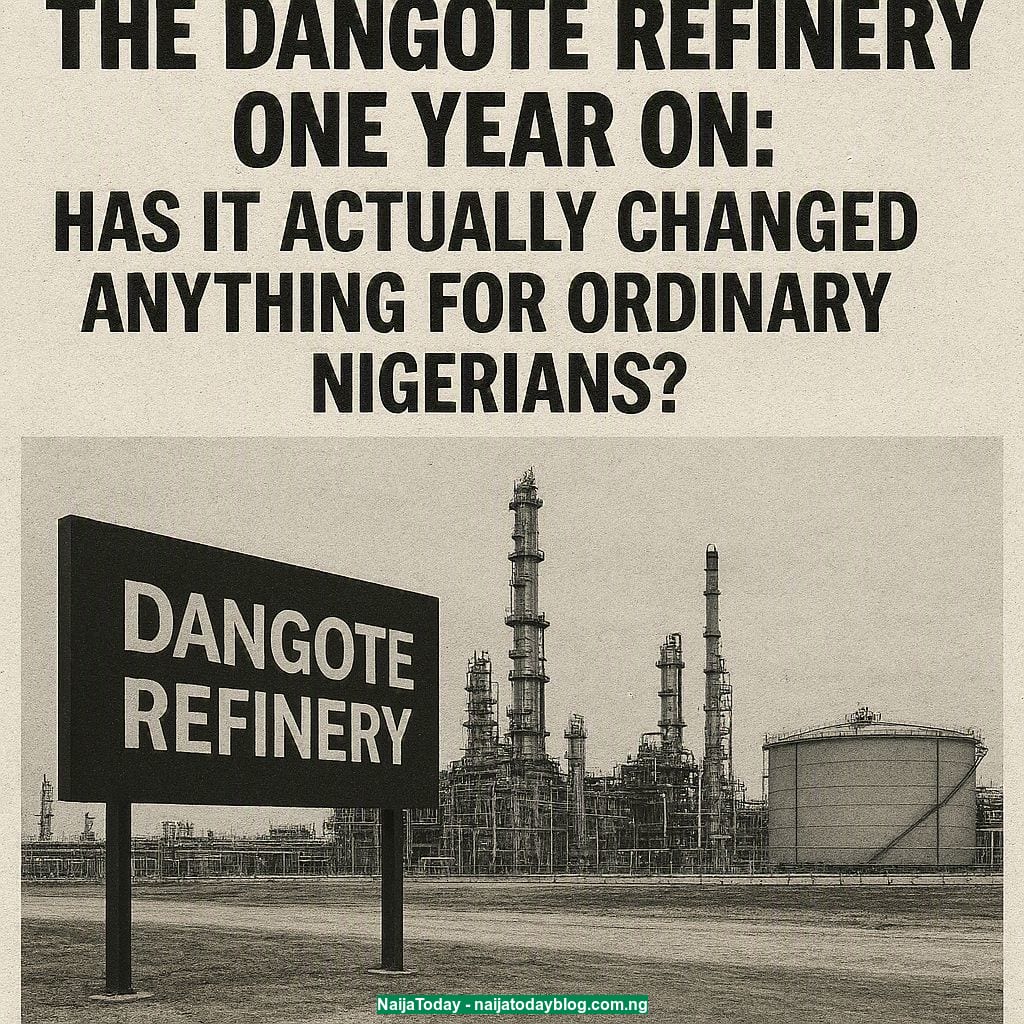
When the Dangote Petroleum Refinery finally began processing crude oil at meaningful scale, the reaction from Nigerians was a mixture of pride, relief, and cautious expectation. Here, at last, was the thing that was supposed to change everything — a 650,000-barrel-per-day refinery sitting on the edge of the Lagos lagoon, the largest single-train refinery in the world, built by a Nigerian for Nigeria.
How does this story make you feel?
No account or sign-in needed. You can react instantly.
Share:
More Stories to Explore
More reporting selected from NaijaToday, based on topics and categories.