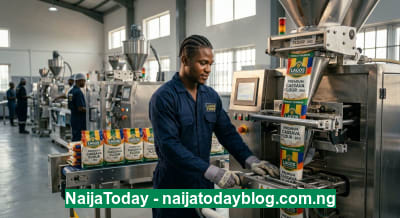
A bag of rice. A
bunch of tomatoes. A litre of groundnut oil. A dozen eggs.
These are not luxuries. They are the building blocks of what Nigerians eat
every day — the ingredients of jollof rice and egusi soup and fried plantain
and all the dishes that make Nigerian food what it is. And in the past three
years, the cost of these basics has increased so dramatically that a
significant proportion of Nigerian families have been forced to reduce how much
they eat, cut back on protein, or skip meals entirely.
Food inflation in Nigeria has been running at some of the highest rates ever
recorded. At its peak in 2024, food inflation exceeded 40 percent. It has
moderated somewhat since — the NBS recorded food inflation at approximately 21
percent in early 2026, still more than double the rate that most economists
would consider acceptable.
This is not an abstraction. It is hunger. And understanding why it is happening
— and what can actually fix it — requires an honest examination of Nigeria's
agricultural system, its infrastructure, its policy environment, and the
political economy that shapes all of them.
Nigeria Grows Enough Food — So Why Is It Expensive?
Here is the first thing to understand about Nigerian food prices: the country
is not suffering from a fundamental inability to produce food. Nigeria is one
of the largest agricultural economies in the world. It is the world's largest
producer of cassava. It produces significant quantities of yam, sorghum,
millet, cowpea, and palm oil. It has enormous potential for rice, wheat,
tomato, and livestock production that is nowhere near fully realised.
The problem is not production alone. The problem is the system that connects
production to consumption — and that system is broken in multiple places
simultaneously.
The Roads That Are Not There
The single most important factor in Nigerian food prices — more important than
climate, more important than inputs, more important than any policy
intervention — is the state of rural roads.
Nigeria's rural road network is, in most parts of the country, inadequate to
the point of being barely functional. Farmers in Benue State — Nigeria's
"food basket" — grow tomatoes, peppers, yams, and vegetables in
quantities that should supply markets across the country. But getting those
goods from the farm to the market requires navigating roads that become
impassable in the rainy season, that destroy vehicles at rates that make
transportation prohibitively expensive, and that can add days to journeys that
should take hours.
The cost of transportation adds directly to the cost of food at the market.
When a truck carries tomatoes from Benue to Lagos and breaks an axle on a
potholed road, the repair cost is recovered from the price of tomatoes. When
the journey takes three days instead of one, the fuel cost is recovered from
the price of tomatoes. When the tomatoes spoil because the journey is too long
for perishable goods to survive, the loss is recovered — or simply absorbed as
a permanent feature of a system that expects losses — and future prices adjust
accordingly.
The Federal Ministry of Agriculture has, under various administrations,
announced rural road programmes. Some roads have been built. The scale of
investment has been consistently insufficient to the challenge, and the roads
that are built are often not maintained, returning to their previous condition
within years of completion.
Post-Harvest Losses: Nigeria's Hidden Food Crisis
Estimates of post-harvest losses in Nigeria's agricultural system range between
40 and 60 percent for certain perishable commodities. This means that for every
two tomatoes grown by a Nigerian farmer, one is lost before it reaches a
consumer.
Post-harvest losses happen at multiple points: in the field, during harvesting;
in storage, where inadequate facilities allow pests, disease, and spoilage to
destroy produce; in transportation, where poor roads and inadequate cooling
extend journey times beyond what perishables can withstand; and at the market,
where unsold produce spoils because supply and demand are poorly
coordinated.
The aggregate food waste implied by these loss rates is staggering. It means
that Nigeria is effectively importing a significant portion of its food
insecurity — not because it cannot grow food, but because it cannot efficiently
move, store, and preserve the food it grows.
Cold chain infrastructure — the network of refrigerated storage, refrigerated
transport, and temperature-controlled market facilities that reduces
post-harvest losses in modern agricultural systems — is dramatically
underdeveloped in Nigeria. This is partly a chicken-and-egg problem: cold chain
infrastructure requires reliable electricity, and Nigeria does not have
reliable electricity. But it is also a problem of investment priority and policy
attention.
The Insecurity That Empties Farms
No analysis of Nigerian food prices can ignore the role of insecurity.
The conflict between herders and farming communities — concentrated in the
north-central states, particularly Benue, Plateau, Nasarawa, Kaduna, and Niger
— has driven farmers off their land at scale. Communities that produced food
for themselves and for markets have been displaced by violence, leaving
farmland fallow and reducing the supply of agricultural produce in affected regions.
In Benue State in June 2026, an attack on a farming community killed 59 people.
This is not an isolated incident. It is the latest in a pattern of violence
that has continued for years, with devastating consequences for agricultural
production and food security in the affected regions.
Banditry in the north-west has had similar effects. Farmers who cannot go to
their fields because of the threat of attack cannot grow food. Communities
under regular threat of kidnapping or raid cannot maintain the seasonal rhythms
of planting and harvesting that agricultural production requires.
The connection between insecurity and food inflation is direct and large.
Addressing food prices requires addressing the security situation — not as a
sequential priority, but as a simultaneous one.
Fertiliser, Seeds, and the Input Problem
Nigerian agricultural productivity — the amount of food produced per hectare of
land — is significantly lower than comparable countries in similar climatic
zones. A significant part of the explanation is the inadequate availability and
affordability of quality agricultural inputs: fertiliser, improved seed
varieties, and crop protection products.
The federal government subsidises fertiliser through various programmes, but
the implementation of these programmes has been characterised by the same
dysfunction that affects most Nigerian subsidy programmes: leakages, diversion,
and the tendency for subsidised inputs to end up with politically connected
distributors rather than with the small-scale farmers who need them most.
Improved seed varieties — drought-tolerant, pest-resistant, high-yield
varieties that can significantly increase productivity — are available but not
widely adopted, partly because of cost and partly because of inadequate
extension services that would help farmers understand and use them
effectively.
The agricultural extension service — the network of government-employed
agricultural advisors who should be working with farmers to improve their
practices — has been chronically underfunded and understaffed for decades. Most
Nigerian farmers, particularly small-scale farmers, make their agricultural
decisions based on inherited practice rather than current agronomic
knowledge.
What Is Actually Working
Not everything is broken. There are genuine successes in Nigerian agriculture
that deserve recognition — both because they demonstrate what is possible and
because they point toward solutions.
Rice production has increased significantly over the past decade, driven by a
combination of import restrictions, government investment in irrigation and
processing infrastructure, and private sector investment in large-scale rice
farming and milling. Nigeria is not yet self-sufficient in rice, but it is
significantly less import-dependent than it was.
The commercial poultry sector in south-west Nigeria has, despite persistent
challenges with feed prices and disease control, developed into a genuine
industry that supplies a significant proportion of Nigeria's chicken and egg
needs. This has been achieved largely through private investment, with limited
government support.
Cassava processing — converting raw cassava into flour, starch, and ethanol —
is expanding, with companies investing in processing capacity that adds value,
extends shelf life, and creates market opportunities that raw cassava cannot
access.
These successes share common features: they involve value chains where private
investment has been attracted, where there is a large and growing domestic
market, and where the policy environment has been supportive enough not to
actively undermine private initiative.
What Must Change
The path to affordable food in Nigeria requires action on multiple fronts
simultaneously, sustained over years rather than election cycles.
Rural roads need to be built and maintained at a scale that genuinely connects
farming communities to markets. This is not glamorous infrastructure. It does
not cut ribbons as impressively as a new airport or a presidential library. But
it may be the single highest-return infrastructure investment available in
Nigeria.
Post-harvest infrastructure — warehousing, cold storage, processing facilities
— needs investment, both public and private. The government's role is to create
the policy environment that makes private investment viable: reliable
electricity, clear land rights, accessible financing.
The insecurity that is driving farmers off their land needs to be addressed
with the same urgency that security threats to urban centres receive. The lives
of farming communities matter. The food security of the nation depends on
them.
Agricultural extension services need to be revitalised — funded, staffed, and
redesigned to reach smallholder farmers with practical, relevant, current
agronomic knowledge.
Input subsidy programmes need to be redesigned to reach the farmers they are
intended to benefit — using digital identity systems and direct-to-farmer
distribution mechanisms that reduce the leakage that has characterised previous
programmes.
Final Word
Food is not just an economic issue. It is a human rights issue. A security
issue. A dignity issue.
When Nigerian families cannot afford to eat adequately — not because Nigeria
lacks the land, the climate, or the agricultural potential to feed itself, but
because the systems that should connect production to consumption are broken —
that is a policy failure of the first order.
Fixing it requires less grand vision and more grinding, unglamorous, consistent
work on roads, storage, security, and the basic infrastructure that food
systems need to function.
Nigeria can feed itself. It can feed its neighbours. The question is whether it
has the political will to fix the systems that stand between its agricultural
potential and its people's plates.
The answer to that question will show up every day, in markets across the
country, in the price of a bag of rice and a bottle of groundnut oil.
Nigerians are watching. And they are hungry.
NaijaToday covers the economic realities shaping Nigerian lives.*
📍
naijatodayblog.com.ng*
Why Food Is So Expensive in Nigeria — and What Can Actually Fix It
By NaijaToday Business Desk | June 21, 2026** · 22 June 2026 · 7 min · 👁 33

These are not luxuries. They are the building blocks of what Nigerians eat every day — the ingredients of jollof rice and egusi soup and fried plantain and all the dishes that make Nigerian food what it is. And in the past three years, the cost of these basics has increased so dramatically that a significant proportion of Nigerian families have been forced to reduce how much they eat, cut back on protein, or skip meals entirely.
How does this story make you feel?
No account or sign-in needed. You can react instantly.
Share:
More Stories to Explore
More reporting selected from NaijaToday, based on topics and categories.