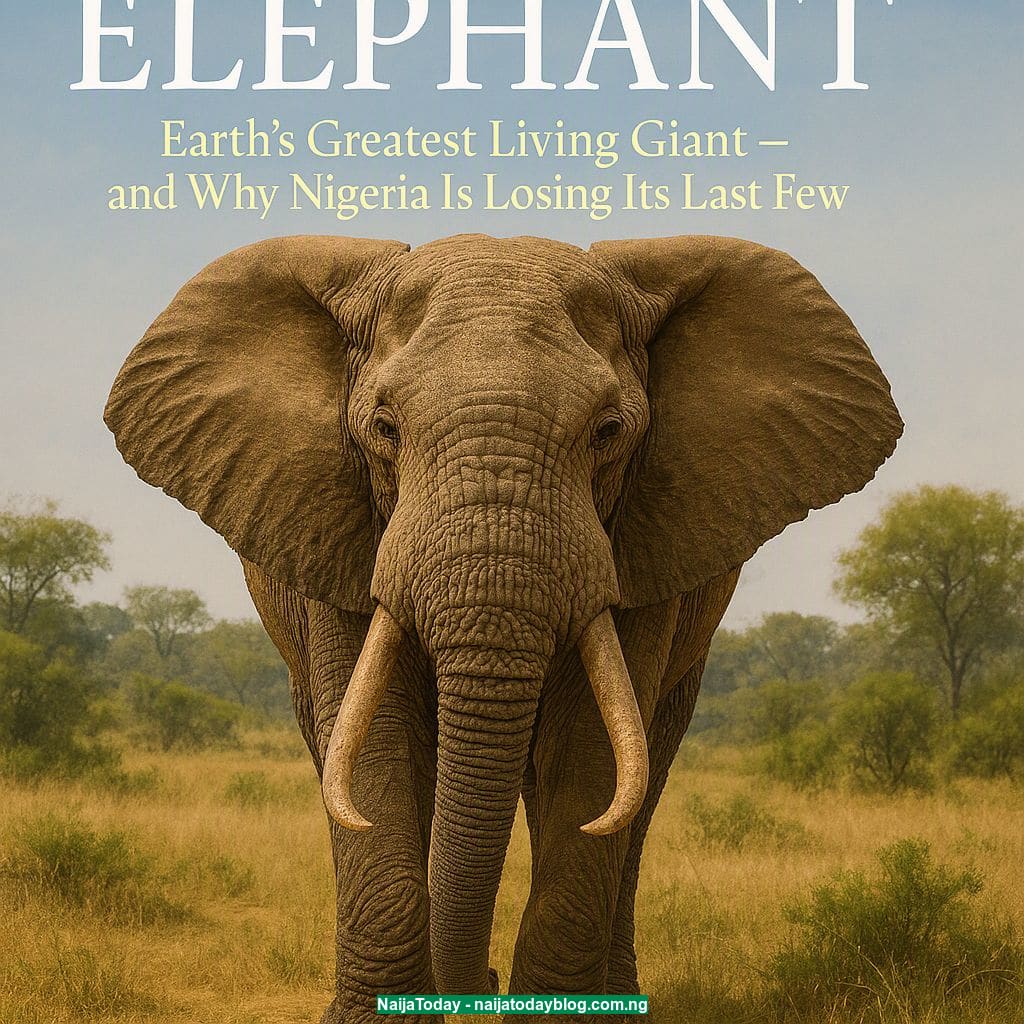
Somewhere deep in the forests of Cross River State, on the 22nd of May 2025, at precisely 4:37 in the afternoon, a camera trap mounted between the trees captured something remarkable.
An African forest elephant — silent, unhurried, enormous — walked quietly across the frame.
For the community of Iko Esai, it was the first confirmed sighting of an elephant in over a decade. "We haven't seen an elephant in our forest for over a decade. This gives us hope that they still belong here," a community member said, his words carrying the particular emotion of someone who had almost given up.
One photograph. One elephant. And yet it felt like a miracle.
That is the state of things. That is what we have come to. In a country that once had between 1,200 and 1,500 elephants roaming freely across its savannas and forests, a single camera trap image is now cause for celebration.
But before we get to what is happening to Nigeria's elephants, let us first understand what kind of creature we are talking about. Because the elephant is not just another animal. It is, without exaggeration, one of the most extraordinary beings that has ever walked this planet.
The Largest Land Animal on Earth
The African elephant is the largest land animal alive today. A fully grown male African bush elephant — called a bull — can stand over 3.5 metres tall at the shoulder and weigh as much as 6,000 kilograms. To put that in perspective: that is roughly the combined weight of four mid-sized cars. When one of these creatures moves through the forest, the ground trembles.
There are two distinct species of African elephant: the savanna elephant (Loxodonta africana) and the forest elephant (Loxodonta cyclotis). For many years, scientists debated whether they were the same species. Genetic studies eventually confirmed they are not — they are as distinct from each other as lions are from tigers. Both species exist in Nigeria, though in devastatingly small numbers.
Then there is the Asian elephant (Elephas maximus), found across South and Southeast Asia, which is smaller than its African cousins and distinguished by its rounded back, smaller ears, and a single-domed head.
All three species share the same essential truth: they are ancient, they are intelligent, and they are in danger.
A Brain That Rivals Our Own
Here is something that might stop you in your tracks.
A landmark study published in PNAS Nexus in May 2025 by researchers from Humboldt-Universität zu Berlin and the Leibniz Institute for Zoo and Wildlife Research made a finding that sent waves through the scientific community: elephant brains triple in weight after birth — a postnatal growth trajectory that directly parallels human brain development and far exceeds that of other primates, including chimpanzees.
The elephant brain weighs between 4.4 and 5.6 kilograms. The human brain weighs approximately 1.4 kilograms. And yet, the trajectory of how both brains develop — slowly, over years of childhood, shaped by experience and social learning — is remarkably similar.
This is not a coincidence. It is a window into the kind of intelligence that lives inside an elephant.
Elephants have demonstrated the ability to recognise themselves in mirrors — a test of self-awareness that most animals fail. They use tools: sticks to scratch themselves, leaves as fly swatters, branches to plug waterholes. They solve complex physical problems. They cooperate to achieve goals that neither individual could accomplish alone. They understand pointing — the ability to follow a human's finger to a target — without being trained to do so.
Perhaps most strikingly, long-term field studies spanning over 40 years in places like Amboseli National Park in Kenya have documented something that still gives scientists pause: elephants remember. Not just their own family members, but dozens of other individuals across vast landscapes. A matriarch can recognise the calls and faces of elephants she has not encountered in years.
Their spatial memory is extraordinary. They navigate hundreds of kilometres using mental maps of water sources, mineral deposits, and migration corridors — maps built across decades of lived experience and, crucially, passed down from one generation to the next.
This is not instinct alone. This is culture.
The Life Cycle of an Elephant
An elephant's life is, in many ways, a mirror of our own.
Pregnancy and Birth
The elephant has the longest gestation period of any land mammal: 22 months. Almost two full years of pregnancy before a calf enters the world. When the calf arrives, it is already large — weighing around 100 kilograms at birth — and is immediately on its feet, greeted by the entire herd in what can only be described as a celebration. Mothers, aunts, sisters, grandmothers — all gather around the newborn in a rumbling, touching, enveloping welcome.
Infancy and Childhood
The first years of an elephant's life are a masterclass in learning. Calves drink their mother's milk for up to four years and stay close to her side at all times. But it is the extended family — the herd — that truly raises an elephant. Young calves learn what to eat, where to drink, how to behave, how to communicate, how to read threats, and how to read the land — all through observation and imitation of the older elephants around them.
Female calves often stay with their birth herd for life. Male calves begin to drift away in their early teens, eventually leaving to live more solitary lives or form loose bachelor groups, returning to female herds only to mate.
Adolescence and Adulthood
Male elephants go through a remarkable hormonal state called musth — a period of heightened aggression and sexual drive that can last for weeks or months. During musth, testosterone levels in male elephants surge to 60 times their normal level. The temporal glands on the sides of a bull's head secrete a dark, oily substance. They become bold, dangerous, and unpredictable. In the wild, musth is a natural and important part of the reproductive cycle. In human-elephant conflict zones, it can be fatal.
Females reach sexual maturity around the age of ten to twelve years and typically have their first calf between the ages of twelve and fourteen. The average gap between calves is four to six years — a slow reproductive rate that means elephant populations recover extremely slowly from population losses.
Old Age and Death
Elephants can live for 60 to 70 years in the wild. But their lifespan is ultimately limited by their teeth.
An elephant goes through six sets of molars in its lifetime. Each set is gradually worn down by the enormous quantities of rough vegetation the animal consumes daily — up to 150 kilograms of food and 200 litres of water every single day. When the final set of molars is worn down, the elephant can no longer chew. It starves.
Old elephants, sensing the end, often gravitate toward soft vegetation near rivers and swamps. The mythology of elephant graveyards — specific locations where elephants go to die — is romantic but not quite accurate. What is true is that elephants often die near water, and that other elephants show a deep and disturbing awareness of death. They return to the bones of the dead. They touch skulls gently with their trunks. They stand in silence over the remains of family members.
Scientists call this grief behaviour. Anyone who has watched it on film knows that no other word fits.
How Elephants Talk
One of the most astonishing things about elephants is how they communicate — and how much of it is invisible to us.
Elephants produce infrasound: low-frequency rumbles with fundamental frequencies between 14 and 35 Hz, entirely below the threshold of human hearing. These calls travel enormous distances — in the right conditions, several kilometres — through both the air and the ground. Elephants detect these vibrations not only through their ears but through specialised nerve endings in their feet.
Research published as recently as January 2026 continues to expand our understanding of just how sophisticated this communication system is. Elephants have been documented using specific calls to refer to specific individuals — something close to names. They have alarm calls that distinguish between the threat of bees and the threat of humans. They have contact calls, greeting rumbles, mating calls, musth roars, and what researchers have described as comfort sounds — low murmurings made to calves in distress.
A 2025 study found that elephants also use what appears to be referential communication: making sounds that represent specific objects or situations in the external world, rather than just expressing internal emotional states. This places them in a very select group of animals — one that includes humans, great apes, and dolphins.
The Matriarch: The Heart of Everything
At the centre of every elephant herd is the matriarch — the oldest female, the carrier of knowledge, the keeper of the mental map.
She knows where the water is. She remembers which routes are safe. She has lived through droughts and knows where to lead the herd when the dry season becomes desperate. She recognises the voices of dozens of individuals — friends, rivals, strangers — by their calls alone. She is the library of the herd.
When a matriarch dies, the loss reverberates through the entire family unit. Studies have shown that herds without matriarchs make poorer decisions during droughts, are less effective at detecting threats, and are more likely to be involved in human-elephant conflict.
This is why the illegal hunting of elephants for ivory is so devastating beyond the simple arithmetic of numbers. Poachers target the largest animals — which are invariably the oldest. They kill the ones who know the most. They strip away decades of accumulated wisdom in a single gunshot.
Nigeria's Elephants: A Crisis at Our Doorstep
Now we return to Nigeria. And here, the story turns painful.
Nigeria's elephant population has undergone one of the most dramatic collapses of any large mammal population on the continent. Thirty years ago, Nigeria had an estimated 1,200 to 1,500 elephants. Today, that number has fallen to between 300 and 400. That is a decline of more than 70 percent in a single generation.
The country's largest remaining herd — approximately 100 individuals — lives in Yankari Game Reserve in Bauchi State. Smaller groups survive in Cross River National Park, Okomu National Park in Edo State, and Omo Forest Reserve in Ogun State. Two species are present: savanna elephants in the north, and forest elephants — listed as Critically Endangered by the IUCN — in the south.
The forest elephant situation is especially dire. A research expedition to southern Nigeria's protected areas found a total of just 40 forest elephants across four sites. Conservation scientists have noted that a viable elephant population requires at minimum 400 individuals. Nigeria's forest elephant population is one-tenth of that threshold.
And yet, that single photograph from Iko Esai in Cross River State on a warm May afternoon in 2025 — one elephant, walking quietly through a community forest — gave conservationists something they had not expected: proof that the animals are still there, still moving, still trying.
What Is Killing Nigeria's Elephants?
The threats are many, and they compound one another in ways that make recovery desperately difficult.
Poaching for ivory remains the most immediate and lethal threat. Nigeria has become, according to the Wildlife Conservation Society, a major transit point for illegally trafficked ivory from across Africa. Nearly a quarter of all seized ivory in the world passes through Nigerian ports. The demand comes from overseas, but the crime happens here, at the expense of animals that have lived in these forests for thousands of years.
Habitat loss is perhaps the deeper, slower killer. Nigeria's forests are shrinking. Agriculture, urbanisation, and infrastructure expansion are eating into the land that elephants need to survive. When habitats are fragmented, elephants cannot migrate. They cannot find mates beyond their immediate group. Genetic diversity collapses. Populations become inviable.
Human-elephant conflict is the consequence of that shrinking habitat. When elephants have nowhere to go, they move into farmland. They eat crops — sometimes entire harvests in a single night. Farmers who have no compensation mechanism and no insurance respond the only way they feel they can: with hostility, sometimes with poison or guns. An elephant that costs a farmer his livelihood is not an elephant that will be protected. The Federal Government of Nigeria currently has no policy provision to compensate farmers for crop losses from elephant raids — a gap that is costing both human livelihoods and elephant lives.
Signs of Hope
Not everything is despair. There are people fighting, and some of them are winning.
The Nigerian Conservation Foundation and the Nature and Biodiversity Conservation Union launched a Community Forest Management project across eight buffer communities in Cross River State in 2023. The results — including that remarkable camera trap image — suggest that when communities are brought into conservation as partners rather than treated as obstacles, elephants can begin to return.
The Wildlife Conservation Society has been working in Nigeria since 2001, supporting conservation across Cross River State and Yankari Game Reserve.
And in 2024, Nigeria adopted a ten-year National Elephant Action Plan, developed with support from the Elephant Protection Initiative. The plan targets a reduction in poaching, stronger law enforcement, better habitat management, and community involvement. Whether the government commits the financial resources needed to bring it to life remains to be seen.
The Endangered Species Conservation and Protection Bill, passed by the House of Representatives in 2024, is now with the Senate. If signed into law, it would significantly strengthen Nigeria's ability to combat wildlife crime.
These are reasons — not to relax — but to keep pushing.
Why It Matters to Every Nigerian
You might ask: why should a reader in Lagos or Kano or Port Harcourt care about a few hundred elephants in Bauchi or Cross River?
Here is why.
Elephants are what scientists call a keystone species — an organism so central to its ecosystem that its removal causes the entire system to collapse. Elephants disperse seeds across vast distances, creating the conditions for forest regeneration. They dig waterholes that other animals depend on. They create paths through dense vegetation that smaller animals use. They are, in the truest sense, ecosystem engineers.
Nigeria's biodiversity — its forests, its water sources, its wildlife — is not separate from the wellbeing of its people. It is the foundation of it. When we lose the elephant, we do not just lose a magnificent animal. We begin to lose the forest itself.
And the forest, in the end, is not something we can afford to lose.
Final Word
The elephant has walked this earth for millions of years. It has survived ice ages and mass extinctions and the slow grinding of geological time. It has developed one of the most sophisticated minds in the animal kingdom, built civilisations of memory and relationship and culture, and filled Africa's landscapes with a presence so commanding that every culture that has ever encountered it has been changed by the meeting.
In Iko Esai, Cross River State, on a quiet afternoon in May 2025, one of these creatures walked across a camera trap and reminded a community — and a country — that it was still here.
The question Nigeria must now answer honestly, urgently, and collectively is this: will it still be here in another decade?
The answer is not in the hands of the elephant.
It is in ours.
NaijaToday covers the stories that matter — from the football pitch to the forest floor. 📍 naijatodayblog.com.ng