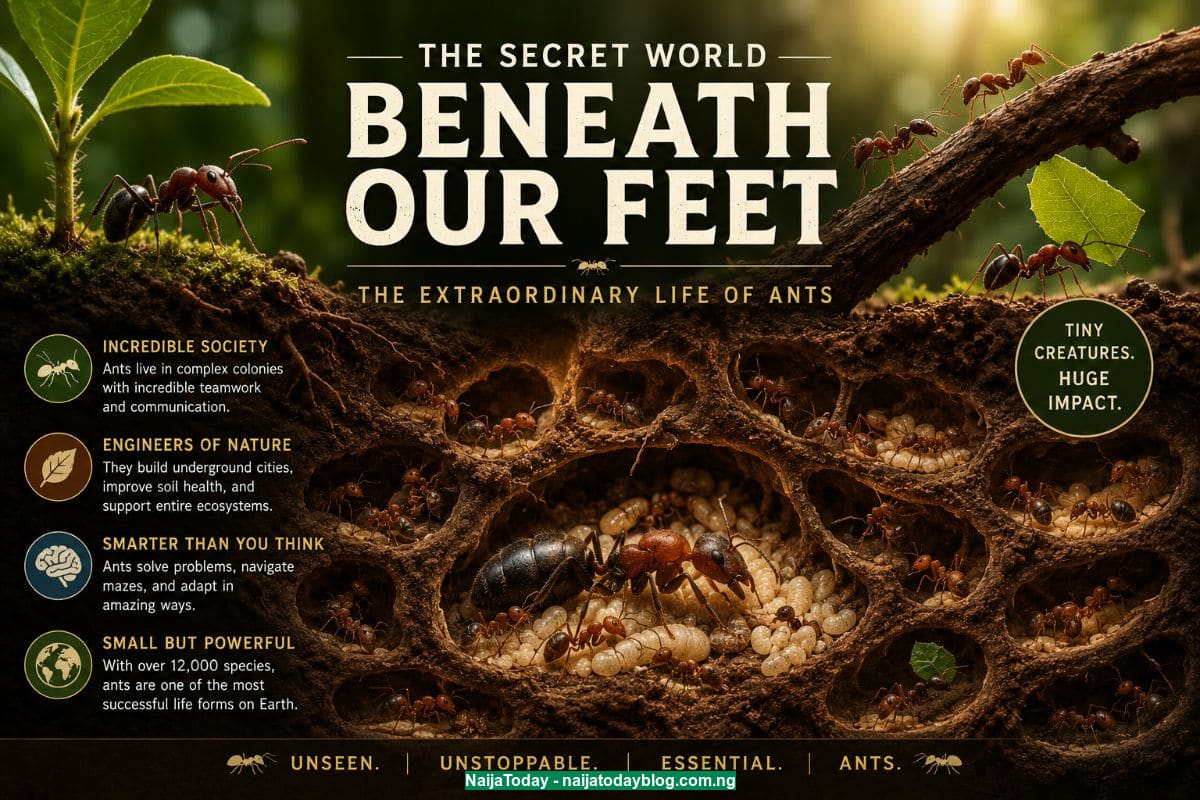
They have been walking this earth for over 140 million years — surviving the asteroid that wiped out the dinosaurs, outlasting empires, and colonising every continent except Antarctica. If you were to weigh every ant alive today, the combined mass would rival the total weight of all humanity.
That is not a small thing. That is a force of nature in miniature.
Born Into a Role: The Ant Caste System
From the moment an ant egg hatches, its destiny is largely fixed. Ant colonies operate on a strict caste system — not decided by wealth or family name, but by biology and the needs of the colony at any given time.
At the top sits the queen. She is the mother of the entire colony, sometimes living for 20 to 30 years — an extraordinary lifespan for an insect. Her sole purpose, once she has shed her wings after her mating flight, is to lay eggs.
A mature queen of certain species can produce up to one million eggs in her lifetime. She does not govern in the way a human monarch might. She does not give orders. She simply reproduces, and in doing so, keeps the colony alive.
Then come the workers — all of them female. These are the ants you see marching in lines across your floor or raiding a forgotten biscuit. Workers handle everything: foraging for food, nursing larvae, excavating tunnels, defending the nest, and even carrying out the dead. Different workers often specialise as they age.
Younger ants tend to nurse eggs and larvae inside the nest, while older, more expendable ants venture outside to forage — a biological wisdom, since outside is where the dangers are.
Male ants, interestingly, have the shortest and most singular life. Their only purpose is to mate with a young queen during the nuptial flight — the spectacular aerial mating event where winged queens and males swarm together in the sky. Once mating is complete, male ants die within days.
They do not work. They do not fight.
They exist solely to pass on genetic material and then expire.
The Superorganism: One Colony, One Mind
Perhaps the most remarkable thing about ants is that no single ant is truly running the show.
There is no manager, no supervisor, no central brain issuing commands. And yet, an ant colony of half a million individuals operates with the kind of coordinated precision that any logistics company would envy.
Scientists describe ant colonies as a superorganism — a collection of individuals that together function as a single living entity. Each ant is less like an independent creature and more like a cell in a body. Alone, an ant is limited and vulnerable. Together, they become something almost intelligent.
This coordination happens through chemistry. Ants communicate almost entirely through pheromones — chemical signals released from glands in their bodies. When a forager ant finds food, it lays a pheromone trail back to the nest. Other workers follow the trail, reinforce it with their own pheromones, and soon you have that familiar long line of ants marching purposefully toward your open tin of Milo. When the food runs out, ants stop reinforcing the trail and the scent fades — a self-correcting system that requires no supervisor.
When danger arrives, alarm pheromones spread through the colony in seconds, triggering an immediate defensive response. When a queen dies, the absence of her pheromones signals the colony that something is wrong, sometimes prompting workers to begin raising new queens from existing larvae. It is a living, breathing, chemical internet.
Architects and Engineers
If you have ever had the misfortune of disturbing a large ant mound in a Nigerian garden, you will have glimpsed something of the engineering that goes on beneath the surface. Ant nests are not random holes in the ground.
hey are carefully designed structures with chambers for the queen, nurseries for eggs and larvae, food storage rooms, waste disposal areas, and ventilation shafts.
Leafcutter ants of South America — one of the most studied species in the world — construct underground cities that can extend three metres deep and house millions of individuals. Within these nests, they cultivate fungus gardens, chewing up leaf material to create a compost on which their preferred fungus grows.
They are, quite literally, farmers — and they have been farming for over 50 million years, long before any human picked up a hoe.
Army ants, found across West Africa including Nigeria, take a different approach entirely. They build no permanent home. Instead, the colony moves constantly, with worker ants linking their own bodies together using hooked claws to form temporary living structures — bridges, walls, even cradles for the queen and larvae.
This phenomenon, called a bivouac, is the ant colony wearing itself as a shelter. It is one of the most astonishing sights in the natural world.
War, Slavery, and Survival
The world of ants is not all cooperative harmony.
It is also brutal, territorial, and unforgiving.
Ant colonies regularly go to war with neighbouring colonies of the same or different species over territory, food, and resources. Some species engage in battles that last for days, with thousands of casualties on both sides. Fire ants — increasingly common in parts of Nigeria — are notorious for their aggressive defence and their painful, burning sting.
Some ant species have evolved one of the strangest survival strategies in nature: slave-making.
Species like Polyergus raid the nests of other ant species, stealing their pupae and bringing them back to their own colony. When the stolen ants hatch, they instinctively begin working — not knowing they are in a foreign colony.
The slave-making ants, over generations, have become so specialised for raiding that they can no longer feed themselves and depend entirely on their captive workers to survive.
It is a deeply unsettling arrangement, and a reminder that nature selects for whatever works, not for what is kind.
The Ant and the Tree: Ancient Partnerships
Not everything about ants is conflict. Some of their most fascinating behaviours involve deep, mutually beneficial partnerships with other species — what biologists call mutualism.
In tropical Africa, certain ant species live inside the hollow thorns of acacia trees. The tree provides the ants with shelter and even produces special sugar-rich food bodies for them. In return, the ants fiercely attack any animal — insect, caterpillar, or even large mammal — that tries to eat the tree's leaves.
The tree essentially employs an army. Remove the ants, and the tree becomes vulnerable. Remove the tree, and the ants lose their home. Neither can fully thrive without the other.
Similarly, many ant species tend to aphids the way humans tend to cattle. Ants stroke aphids with their antennae to stimulate the release of honeydew — a sweet liquid the ants consume as food. In exchange, ants protect the aphids from predators and sometimes carry them to fresh feeding spots on plants. It is agriculture and livestock management, evolved independently by insects millions of years before humans thought of it.
What Ants Are Telling Us About Ourselves
Scientists study ants not just because they are fascinating in themselves, but because ant colonies offer striking parallels to human society — and sometimes, uncomfortable mirrors.
Ant colonies solve complex problems without centralised control, which has inspired algorithms now used in computer science, logistics, and artificial intelligence. The way ants find the shortest path between food and nest has directly influenced how internet traffic is routed and how delivery companies plan their routes.
Ant societies also raise profound questions about individuality versus collective good. In a colony, the individual ant sacrifices everything for the group — working without rest, dying in defence, existing purely in service of the whole. It raises a question worth sitting with: what is the right balance between personal ambition and collective responsibility in our own communities?
Ants in Nigerian Culture and Daily Life
Closer to home, ants have long held a place in Nigerian folk wisdom.
The sight of ants moving in large numbers is often read as a sign of coming rain — and entomologists confirm there is truth in this, as many ant species are sensitive to changes in atmospheric pressure and will move their eggs to higher ground before a downpour.
The weaver ant (Oecophylla longinoda), called kokoro in Yoruba and known across the country for its painful bite, is also recognised in many communities as a sign of a healthy, biodiverse environment.
Farmers in parts of southwest Nigeria have traditionally used weaver ant colonies as natural pest control, understanding intuitively what science has since confirmed — that these ants suppress many agricultural pests better than some chemical sprays.
Even in cuisine, ants make an appearance. In several Nigerian communities, winged ants caught during their nuptial flight — known as esunsun in Yoruba — are roasted and eaten as a seasonal delicacy, rich in protein. Far from being pests in this context, they are a gift from the season.
Final Thought
The next time you see a line of ants moving with quiet determination across a surface, pause for a moment before reaching for the insecticide. You are looking at 140 million years of evolution.
You are watching a superorganism solve problems in real time. You are witnessing a civilisation that has outlasted every empire human beings have ever built.
They do not need our admiration to survive. But they might deserve it.
Published by NaijaToday Science Desk. Got a nature story from your community? Email us at kujopatu@gmail.com