Nigeria's Insecurity Crisis Explained: Causes & Data
Category: Forum | Author: NaijaToday Desk | Published: Fri Aug 07 2026
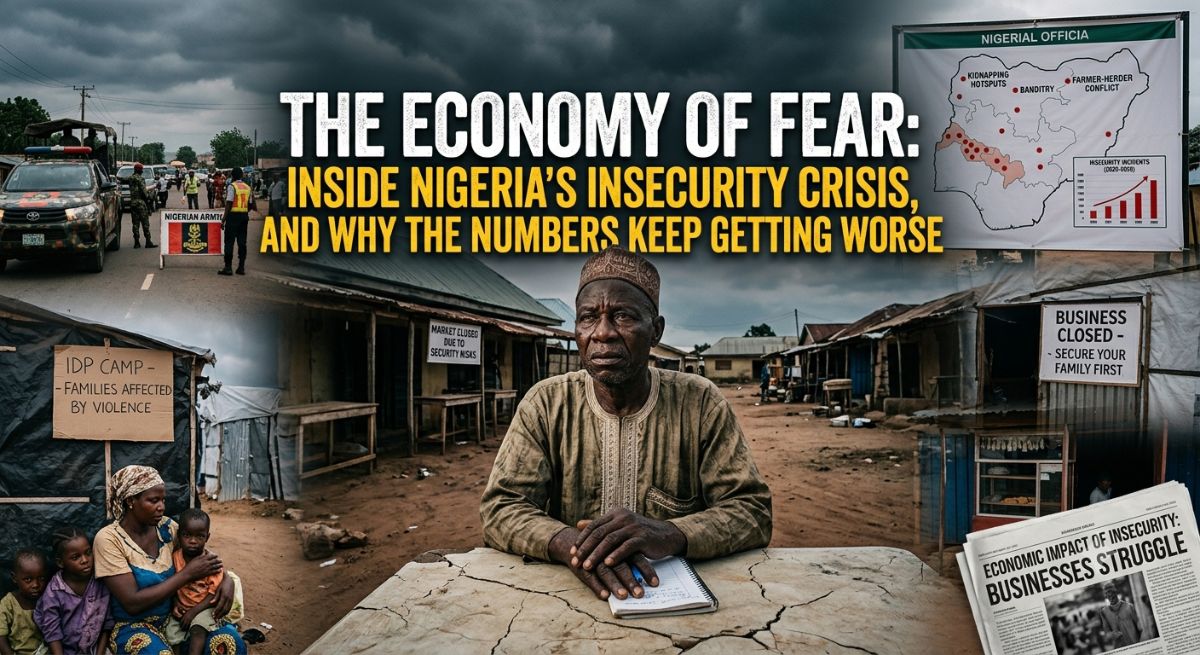
Why does Nigeria's insecurity crisis persist despite rescues and recruitment drives? A deep look at the banditry economy, real data, and root causes.
A NaijaToday Feature There is a particular kind of exhaustion that has settled over large parts of Nigeria — the exhaustion of communities that have stopped asking if the next attack will come, and started asking only when. In villages across Zamfara, Sokoto, Katsina and Benue, families now build their lives around a threat they cannot see coming and a government response that, for all its announcements, has struggled to keep pace with the violence. This week alone brought both halves of that story at once: the Presidency celebrating the rescue of over 300 kidnap victims in a single coordinated operation, even as fresh attacks tore through four states in the same seven days. To understand why Nigeria keeps oscillating between these two headlines — triumph and tragedy, often in the same week — you have to understand how this crisis actually works, not just how it's reported. A Crisis With No Single Name Part of what makes Nigeria's insecurity so hard to fix is that it isn't one crisis. It's at least four, overlapping and occasionally feeding into each other, each with its own logic. In the NorthEast, the story is the one most outsiders know: the longrunning Boko Haram insurgency, now over 16 years old, which has recently seen a resurgence of its JAS faction with deadly attacks concentrated in Borno State, the conflict's original epicentre. In the NorthCentral states — Benue, Plateau, Nasarawa — the driver is decadesold tension between predominantly Muslim herding communities and Christian farming communities, tension that flared again through the first half of 2026 and has claimed lives in Benue as recently as this past July. In the SouthEast, a smaller but persistent thread of Biafran secessionist activity continues to produce clashes with security forces. And in the Niger Delta and SouthSouth, a rise in criminal gang activity has added yet another layer to an already strained security architecture. But the crisis dominating headlines week after week — the one behind most of the masskidnapping stories you've read about this year — is banditry in the NorthWest. And according to researchers who study it closely, calling it "banditry" almost undersells what it has become. The Anatomy Of A Kidnapping Economy Analysts increasingly describe what's happening in Zamfara, Kaduna, Sokoto and Katsina not as sporadic crime but as an entire informal economy built on fear. Armed groups — some purely criminal, some blurring into loosely ideological territory, almost none of them formally aligned with jihadist movements despite persistent conflation in public discourse — have established what one recent security analysis called "protogovernance systems": networks that impose informal rules, extract resources, and shape the daily behaviour of entire communities in places where the Nigerian state has limited or only episodic presence. The scale of it is staggering once you look past any single week's headlines. A report by Lagosbased risk firm SBM Intelligence fou