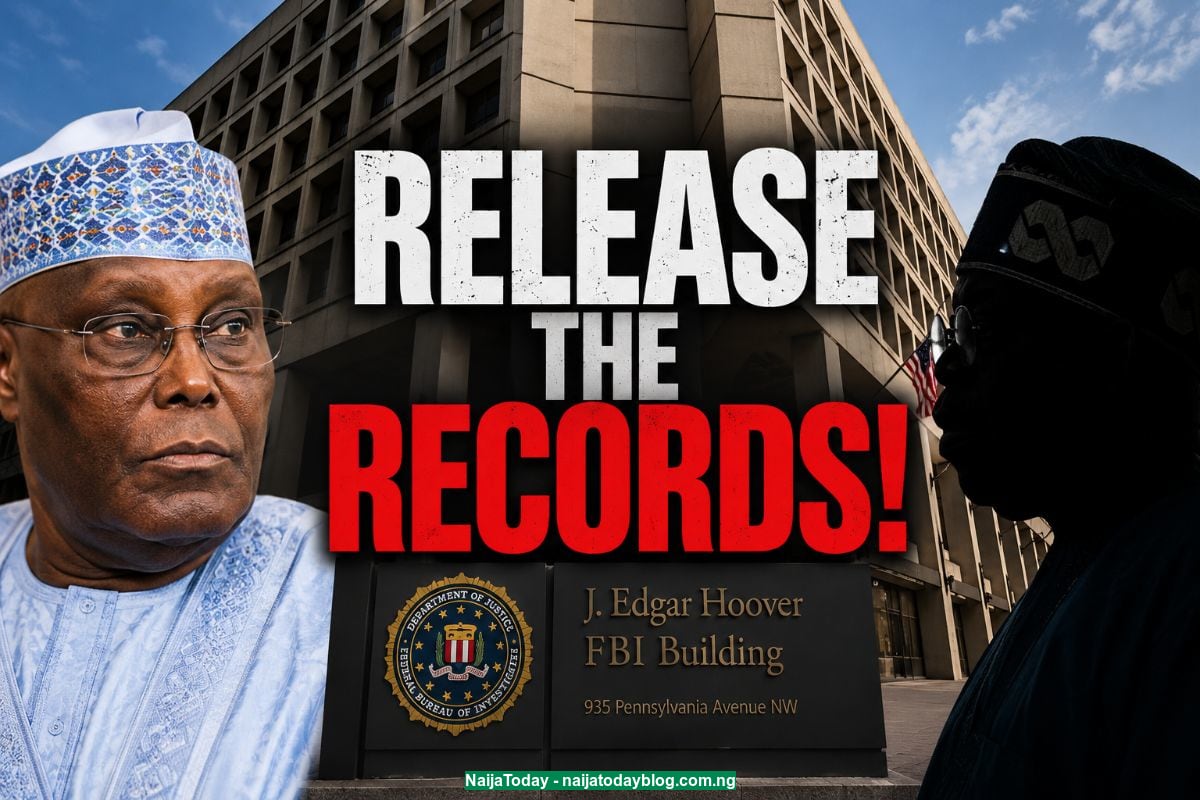
Atiku Challenges the FBI: "Release Tinubu's Records
— Don't Hide the Truth From Nigerians"
If you thought Atiku Abubakar was done making bold moves
after filing his certificate forgery suit against President Tinubu in a
Nigerian federal court earlier this week, think again.
The African Democratic Congress presidential candidate has
now taken his fight to an entirely different jurisdiction — one that operates
far beyond the reach of Nigerian courts, Nigerian political pressure, and
Nigerian party machinery.
He has challenged the United States Federal Bureau of
Investigation directly.
His message to the FBI was blunt, public, and unambiguous:
"Release Tinubu's Records! Don't hide the truth from
Nigerians!"
In the space of one week, Atiku has filed a lawsuit in a
Nigerian federal court, demanded INEC produce Tinubu's certificate documents,
and now called on the most powerful domestic law enforcement agency in the
world to release records relating to the Nigerian president.
The 2027 campaign has barely begun. And it is already unlike
anything Nigeria has seen before.
What Is Atiku Demanding From the FBI — and Why?
To understand Atiku's FBI challenge, you need to understand
the history.
In 1993, the United States Drug Enforcement Administration
filed a civil forfeiture case in the Northern District of Illinois involving
accounts linked to Bola Tinubu. That case — which never resulted in criminal
charges against Tinubu — ended with a settlement in which Tinubu agreed to
forfeit $460,000 to the US government.
Tinubu has always maintained that this was a civil matter,
not a criminal conviction, and that it does not constitute a drug trafficking
conviction under Nigerian law.
His critics — and Atiku is now the most prominent among them
— have long argued that the full records of that US case contain information
that Nigerians deserve to see before deciding whether to re-elect Tinubu as
their president.
What Atiku is specifically demanding is that the FBI — which
would have been involved in the investigation that preceded the civil
forfeiture — release all records related to Tinubu that it holds under the
Freedom of Information Act, and make those records publicly available.
He frames this not as a legal strategy but as a democratic
imperative.
"The Nigerian people have a right to know the full
truth about the person asking for their votes for a second term," Atiku's
camp said in a statement. "If there is nothing to hide, the records should
speak for themselves."
Has This Been Tried Before?
This is not the first time Nigerians have sought access to
US records related to Tinubu. The 1993 forfeiture case has been public
knowledge in some form since at least 2003, when Tinubu first ran for governor
of Lagos State.
What's different now is the political context and the person
making the demand.
In 2023, during the presidential election, various
opposition figures and media organizations attempted to amplify the US case
records. The documents that were publicly available — particularly from US
court filings — circulated widely on social media. But the full investigative
record held by the FBI and DEA was never publicly released.
Atiku is now making the demand formally, publicly, and in
the middle of a presidential campaign. He is essentially daring both the FBI
and Tinubu to either release or actively resist the release of these records.
This puts the FBI in an interesting position. Under the US
Freedom of Information Act, individuals and organizations can request
government records. The FBI regularly responds to such requests — though it can
also withhold records on national security, privacy, or law enforcement
grounds.
Will the FBI comply? That depends on multiple legal factors
that are entirely outside Nigerian political control. The FBI operates on US
law, US precedent, and US timelines. It is not going to rush a records release
because a Nigerian presidential candidate demands it on social media.
But the demand itself creates a narrative. And in political
campaigns, narratives are often as powerful as facts.
The Political Genius (and Risk) of This Move

Let's be honest about what Atiku is doing here. This is not
purely a civic act. It is a sophisticated political maneuver. And understanding
its genius requires understanding how political information works in the age of
social media.
The genius:
By challenging the FBI publicly, Atiku ensures that the
Tinubu drug case stays in the news cycle. Every Nigerian journalist who reports
on the challenge will also have to summarize the underlying allegations. Every
social media user who shares the story will expose new audiences to the 1993
forfeiture. Whether the FBI releases anything or not, the story is alive.
If the FBI says "we are reviewing the request,"
that's a story. If the FBI says "we cannot release these records due to
ongoing investigations," that's an even bigger story. If the FBI releases
records that contain damaging information, that's an explosive story. And if
the FBI simply doesn't respond, Atiku's team will point to the silence as
evidence that someone is hiding something.
In the information environment of a Nigerian presidential
campaign, any of these outcomes serves Atiku's goal of keeping the certificate
and drug case narrative at the center of public discussion.
The risk:
If this gambit is seen as pure desperation — as the act of a
man who has lost in Nigerian courts before and is now chasing shadows in
American files — it could backfire. Voters who are tired of certificate
politics and legal warfare might turn to a candidate who is focused on policy
rather than prosecution.
Peter Obi, notably, has largely stayed away from the
certificate attacks against Tinubu, focusing instead on economic management and
governance competence. That distinction could help Obi's image as a
new-generation leader while Atiku looks like the old guard fighting old
battles.
What Tinubu's Camp Says
Tinubu's spokesman, Sunday Dare, has already been keeping
busy this week responding to attacks from multiple directions. On the FBI
challenge specifically, the expectation is a familiar response: the civil
forfeiture case was resolved decades ago, it was a civil matter not a criminal
conviction, and Atiku is engaged in a desperate campaign of distraction because
he has no positive vision to offer Nigerians.
They have used this framing before. They will use it again.
And to be fair to them, the core factual claim is accurate: Tinubu was never
criminally charged or convicted in any US court. The 1993 matter was a civil
forfeiture settlement. Under Nigerian constitutional law, a civil forfeiture
does not constitute the kind of criminal conviction that would disqualify
someone from holding public office.
But "not convicted" and "nothing to see
here" are very different statements. The Nigerian public — and
particularly the millions of Nigerians who genuinely want to know the full
truth about their president's past — deserves a more complete answer than
"it was just civil."
The International Dimension: When Nigerian Politics Goes
Global
What makes Atiku's FBI challenge historically significant —
regardless of how you feel about the politics — is what it represents for
Nigerian democracy.
Nigerian presidential campaigns have always had
international dimensions. Candidates raise money from diaspora communities.
They consult with foreign policy advisers. They hold meetings in London,
Washington, and Dubai.
But calling on a foreign law enforcement agency to release
records about a sitting Nigerian president — during an active election campaign
— is something different. It is an acknowledgment that Nigerian domestic
institutions alone cannot be trusted to produce full accountability. It is an
appeal to international transparency mechanisms to compensate for what are
perceived as domestic institutional failures.
That's a significant statement about the state of Nigerian
institutions in 2026.
Whether you agree with Atiku's political motives or not, the
underlying principle he is invoking — that a presidential candidate's full
history should be available to voters before they make a decision — is not
unreasonable. The argument that transparency in the public interest supersedes
the privacy interests of a public official seeking re-election has been upheld
in democratic systems around the world.
The question is: will the FBI agree? And if it doesn't, will
that matter?
What Nigerians Actually Need From This Story
Let me cut through the political noise and say something
direct.
Nigerians deserve to know the full truth about all their
presidential candidates. Not just Tinubu. Atiku's own business dealings, his
time as Vice President, his multiple party affiliations, his financial history
— all of this should be publicly available and independently verified.
In a mature democracy, investigative journalism, independent
audit institutions, and transparent disclosure requirements do this work.
Voters don't need to rely on opposition politicians to dig up dirt on
incumbents. Independent institutions do that work.
Nigeria doesn't yet have the full suite of these
institutions operating at the level required. The press is often intimidated.
The EFCC's independence is questioned. The courts are slow. And so campaigns
like Atiku's FBI challenge fill the accountability vacuum.
Is that a satisfactory substitute for real institutional
accountability? No. But it's what we have.
What we need — what Nigeria genuinely needs — is a framework
where every candidate for public office submits to a transparent, independently
verified disclosure of their full background before being allowed on the
ballot. Tax records. Business interests. Criminal history in any jurisdiction.
Sources of campaign funding.
Not because we want to destroy candidates. Because voters
deserve to make informed choices.
Until we build those institutions, the certificate wars, the
FBI challenges, and the court battles will continue — election cycle after
election cycle — because it's the only accountability mechanism anyone can
access.
Do you support Atiku's demand for the FBI to release
Tinubu's records? Should all candidates be fully transparent about their past?
Drop your thoughts below!
📰 Source: Mc Ebisco News,
Nigerian Eye, TheCable, Sahara Reporters 🔗
Naijatodayblog.com