How Nigeria's Fuel Prices Multiplied Sevenfold in Three Years
Category: Politics | Author: NaijaToday Desk | Published: Sat Jul 18 2026
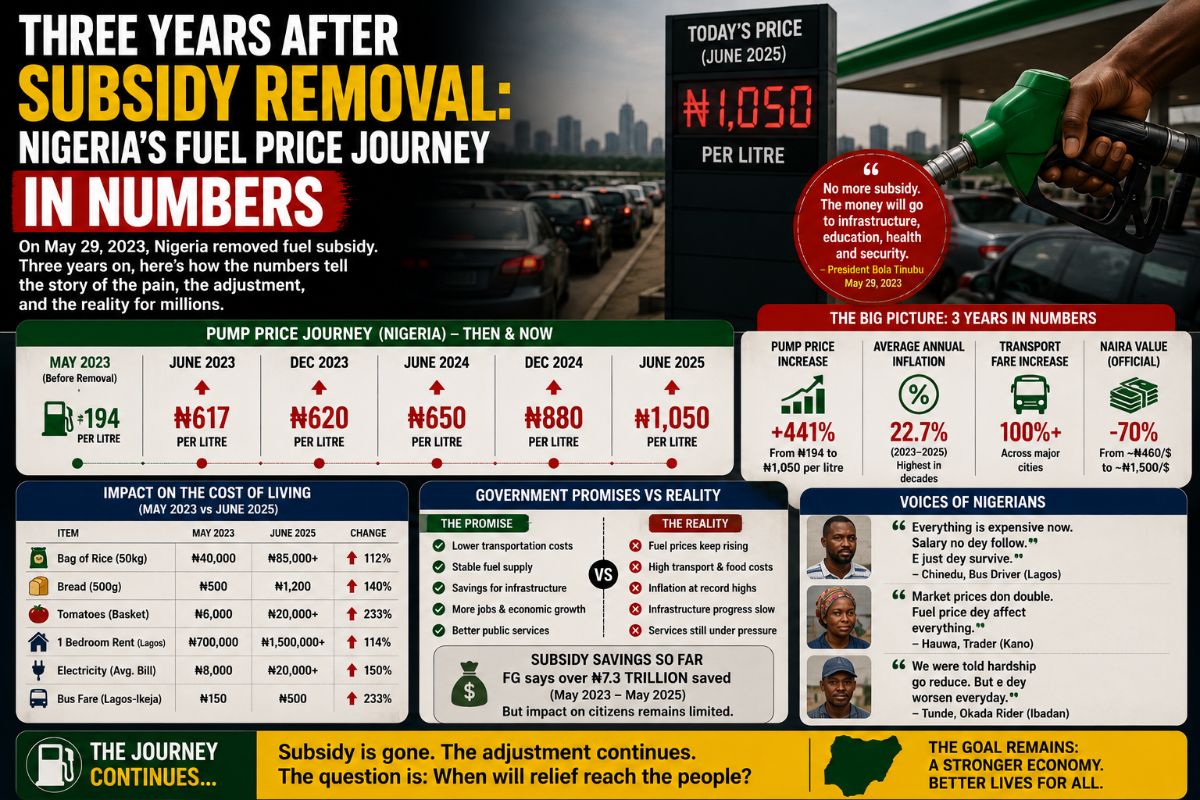
Tracing Nigeria's petrol prices from ₦185 before the 2023 subsidy removal to over ₦1,350 today, and what three years of deregulation has actually delivered.
On May 29, 2023, in the same breath as his inauguration speech, President Bola Ahmed Tinubu delivered a sentence that would reshape the daily arithmetic of nearly every Nigerian household: fuel subsidy is gone. Within days, petrol prices that had held for years at roughly ₦185 to ₦200 per litre more than doubled to around ₦537. It was, by any measure, one of the most consequential policy pivots in Nigeria's recent economic history — and three years on, with a fresh price hike sweeping the country in mid-July 2026, it is worth tracing the full arc of what that decision has meant in naira and kobo, rather than in abstractions. The Numbers, Year by Year The trajectory is stark when laid out in sequence. Before the subsidy removal, Nigerians had grown accustomed to petrol prices that, while occasionally adjusted, remained artificially suppressed by a subsidy regime that, at various points, consumed trillions of naira annually from the federal budget — money that critics argued disproportionately benefited smugglers and well-connected marketers rather than ordinary consumers, while defenders of the subsidy pointed to the real, immediate pain its removal would cause. That pain arrived quickly. By September 2023, further deregulation of the downstream sector pushed prices to approximately ₦617 per litre, as the market adjusted to operating without government price support for the first time in over a decade. Through 2024, as the naira came under sustained pressure against the dollar following the Central Bank's own currency reforms, petrol prices climbed further, settling into a ₦750 to ₦900 range — a period that also saw the gradual ramp-up of the Dangote Refinery's domestic production, introducing the first real counterweight to Nigeria's near-total historical dependence on imported refined fuel. By 2025 and into 2026, prices had settled into a new normal above ₦900, frequently exceeding ₦1,000 per litre, before the events of this past week pushed the market higher still: depot prices rising from ₦1,230 to ₦1,350 per litre starting July 17, 2026, with pump prices expected to follow toward ₦1,380 to ₦1,400 in many parts of the country. Measured from the pre-subsidy-removal baseline of roughly ₦185, that represents better than a seven-fold increase in three years — a pace far outstripping wage growth for the vast majority of Nigerian workers over the same period. What Deregulation Was Supposed to Deliver The policy logic behind the subsidy removal rested on a few core arguments that are worth revisiting now that enough time has passed to judge them against results. Proponents argued that ending the subsidy would free up federal revenue for infrastructure and social investment, eliminate the incentives for cross-border fuel smuggling that had plagued the subsidized regime, and — crucially — attract the private investment needed to build domestic refining capacity, since no investor could justify building a refinery to compete against artificially cheap s