Nigeria at 60-Something: The Country We Were Promised vs The Country We Got
Category: Politics | Author: NaijaToday Desk | Published: Sun Jun 28 2026
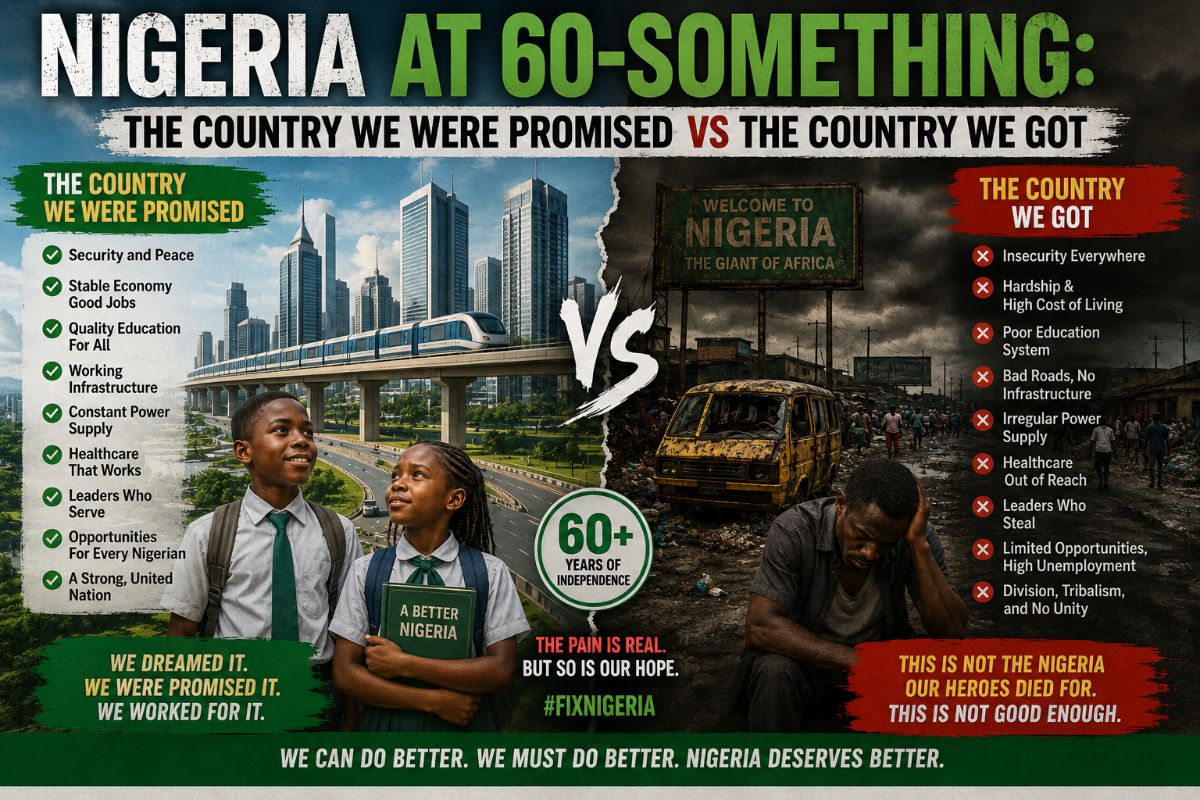
Independence came with a dream. Decades later, Nigerians are still asking the same questions their grandparents asked. What happened to the promise — and who is responsible?
Nigeria at 60-Something: The Country We Were Promised vs The Country We Got A reckoning with independence, disappointment, and the stubborn refusal to give up There is a photograph that surfaces every so often on Nigerian social media — black and white, slightly grainy, from somewhere around 1960 or 1961. In it, Lagos looks like a city on the edge of becoming something extraordinary. The streets are clean in a way that feels almost fictional to anyone who has navigated them recently. The buildings have a mid-century optimism to their architecture. The people in the frame are dressed with a formality and a pride that speaks of a moment that felt, to those living in it, like the beginning of everything. The caption, when someone adds one, is usually some version of the same sentence: We had everything. What happened? It is a question that contains within it a universe of pain. The kind of pain that comes not just from suffering but from the particular anguish of knowing that things were not always this way. That there was a before. That the before was better. And that somewhere between that photograph and right now, something went profoundly, catastrophically wrong. The Dream That Independence Carried To understand contemporary Nigeria, you have to understand what independence felt like — not as a historical fact but as an emotional experience. October 1st, 1960 was not just a date. It was a declaration. It was the moment a people said to the British Empire — to the entire machinery of colonial extraction and cultural humiliation and deliberate underdevelopment — enough . We are ending this now. We are taking our country back. We are going to show you, and ourselves, what we are actually capable of when nobody is holding us down. The optimism of that moment was not naive. It was earned. Nigeria had produced scholars and lawyers and doctors and writers who could compete with anyone in the world. It had oil that was beginning to be discovered in quantities that promised enormous wealth. It had a young population full of energy and intelligence and ambition. It had cultural traditions of governance — in the Yoruba kingdoms, in the Caliphate, in the Igbo systems of republican organisation — that proved Africans had been building sophisticated societies long before any European arrived to tell them they needed to be civilised. The dream was real. The foundation was real. The potential was absolutely, undeniably real. Where It Started to Break The cracks appeared almost immediately. And understanding where they came from matters, because Nigeria has a habit of explaining its failures in ways that let the most culpable people off the hook. The colonial structure that Britain left behind was not designed for Nigerian success. The borders that were drawn — cutting through ethnic groups, forcing communities with centuries of conflict into the same national household, separating communities that belonged together — were drawn for British administrative conven