Naira Holds Near ₦1,370/$ as Official and Black Market Rates Finally Move Closer Together
Category: Business | Author: NaijaToday Desk | Published: Tue Jul 07 2026
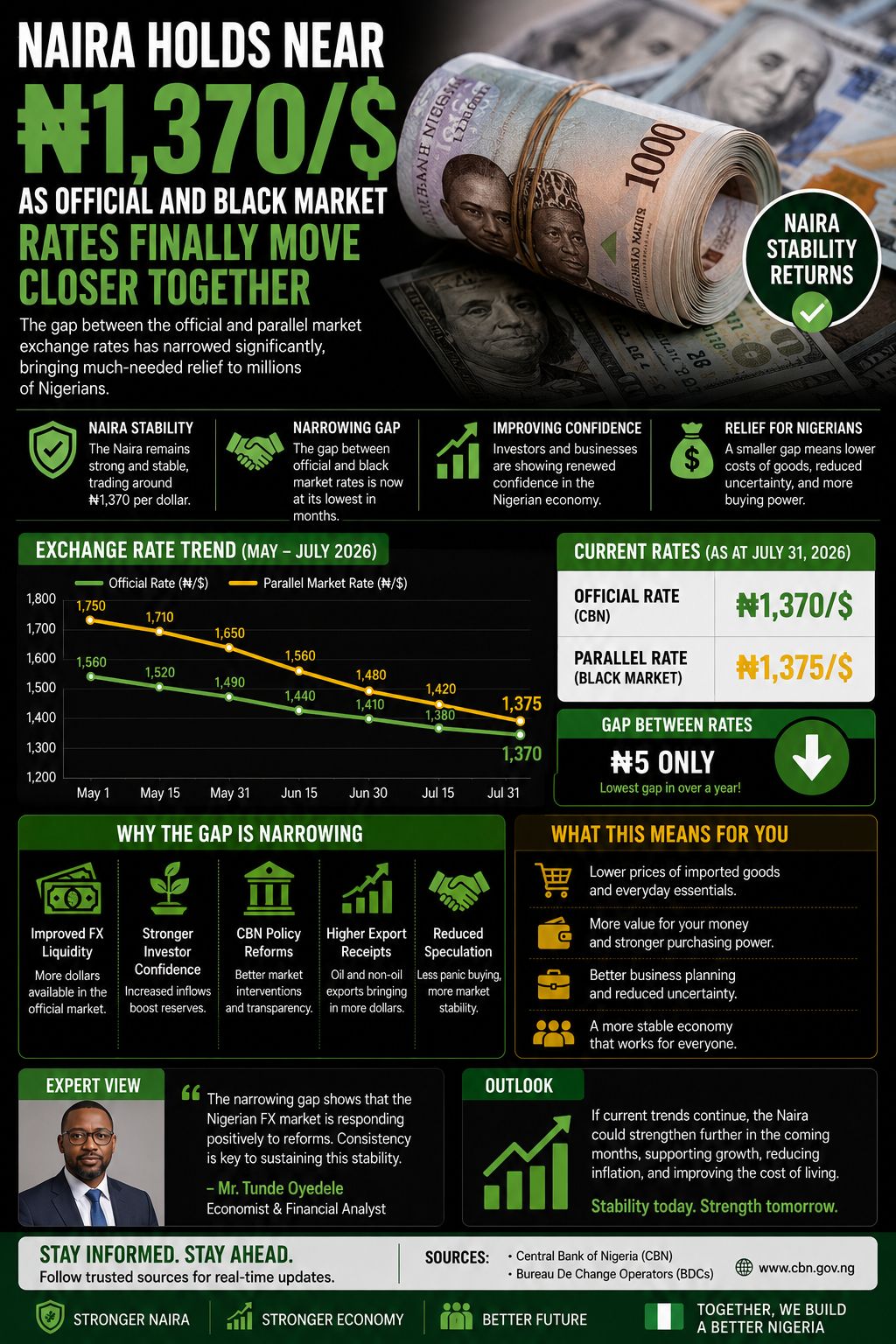
The naira remained stable near ₦1,370 per US dollar as the official exchange rate and black market rate moved closer together. The narrowing gap signals improving foreign exchange liquidity and growing confidence in Nigeria's FX market. Here's what the latest CBN data means for businesses, importers, students paying tuition abroad, and everyday Nigerians.
Naira Holds Near ₦1,370/$ as Official and Black Market Exchange Rates Move Closer Together For years, one of the biggest concerns for Nigerians dealing with foreign currency has been the wide difference between the official exchange rate and the black market rate. Whether you were paying tuition abroad, importing goods, funding an international business, or simply sending money to a family member overseas, the exchange rate often depended on where you sourced your dollars. This month, however, something unusual has happened. The naira appears to be enjoying one of its most stable periods in recent years, with the official exchange rate and the parallel market rate trading at almost the same level. According to data from the Central Bank of Nigeria (CBN) , the Nigerian Foreign Exchange Market (NFEM) closed around ₦1,370.19 per US dollar on July 3, 2026 . At the same time, Bureau De Change (BDC) operators across major commercial cities, including Lagos and Abuja, were selling the dollar for approximately ₦1,369 , leaving only a tiny difference between both markets. Just a day earlier, on July 2, the official market closed around ₦1,374.18 , while the parallel market exchanged at approximately ₦1,385 per dollar. Although these daily movements may seem small, they represent an important shift in Nigeria's foreign exchange market and could signal improving confidence in the naira . Why Everyone Is Talking About the Naira Again For many Nigerians, the exchange rate has become more than just an economic statistic. It affects daily life. The strength or weakness of the naira influences everything from food prices and transportation costs to tuition payments, international travel, online subscriptions, imported electronics, pharmaceutical products, and even the prices of locally manufactured goods that rely on imported raw materials. When the naira loses value against the US dollar, businesses pay more to import goods. Those higher costs are usually transferred to consumers through higher prices. Conversely, when the naira becomes more stable, businesses can plan more confidently, importers experience less uncertainty, and households are less likely to face sudden increases in the prices of everyday products. That is why many financial analysts are paying close attention to the current convergence between Nigeria's official and parallel exchange rates. Why the Gap Between Official and Black Market Rates Matters For several years, Nigeria operated with a noticeable difference between the official exchange rate and the rate obtainable in the parallel market. This gap often reflected the availability—or lack—of foreign currency within the official financial system. When dollars became difficult to obtain through commercial banks or official CBN channels, individuals and businesses turned to Bureau De Change operators or the informal market. As demand increased outside official channels, the black market exchange rate often rose significantly above the offici