Nigeria's Economy Just Exited Contraction — So Why Doesn't It Feel Like It?
Category: Business | Author: NaijaToday Desk | Published: Wed Jul 15 2026
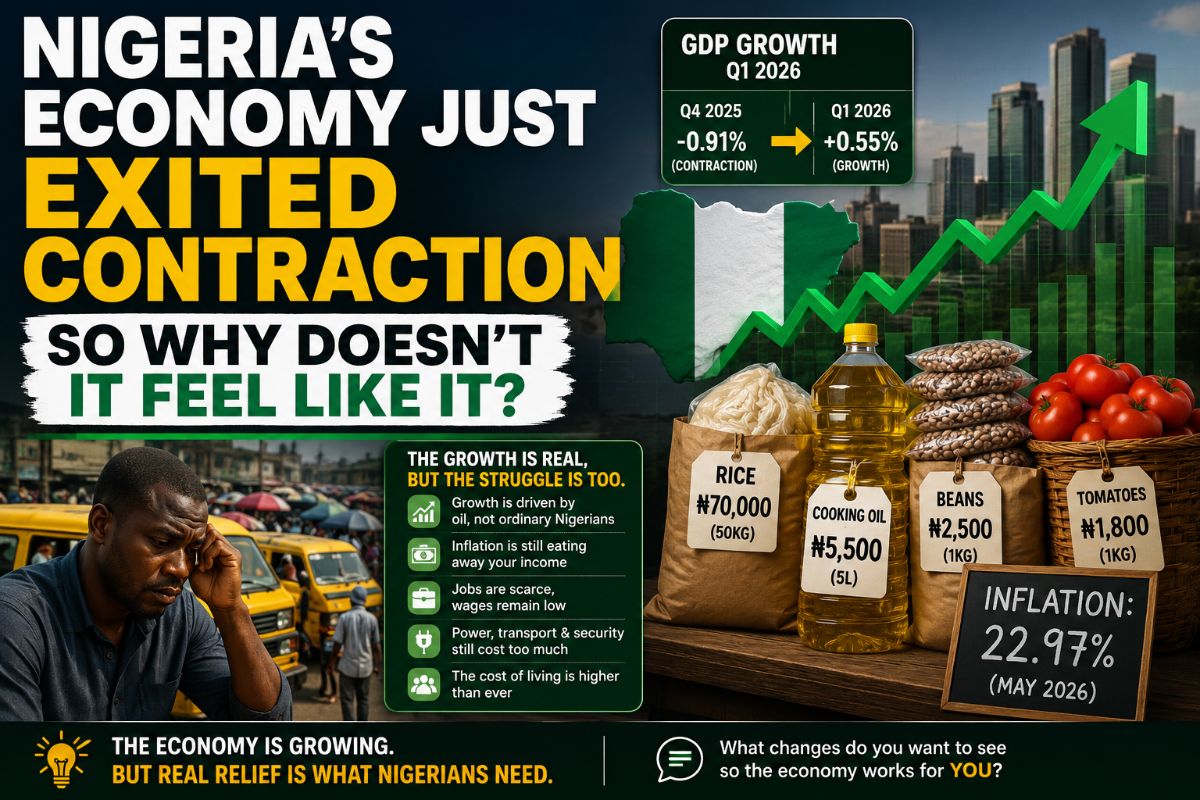
A closely watched measure of Nigeria's business activity has just crossed back above the line separating growth from contraction — technically good economic news. But if you're managing a household budget, running a small business, or scrolling past yet another price increase at the market, that headline probably doesn't match your daily reality. This article breaks down why both things can be true at once, and what it actually means for your business decisions going forward.
A closely watched measure of Nigeria's business activity has just crossed back above the line separating growth from contraction — technically good economic news. But if you're managing a household budget, running a small business, or scrolling past yet another price increase at the market, that headline probably doesn't match your daily reality. This article breaks down why both things can be true at once, and what it actually means for your business decisions going forward. What Actually Happened Nigeria's Purchasing Managers' Index (PMI) — a survey-based measure that tracks whether business activity across manufacturing, services, and other sectors is expanding or shrinking — climbed back above the critical 50-point threshold. Above 50 signals expansion; below signals contraction. The improvement was driven mainly by continued strength in agriculture, one of the more resilient parts of the Nigerian economy even through recent turbulence. At roughly the same time, a separate consumer confidence reading told a noticeably different story: household spending confidence actually dipped, with most Nigerian families continuing to prioritise food spending over larger purchases like vehicles, housing, or long-term investments. Why Two "Correct" Numbers Can Tell Opposite Stories This isn't a contradiction or bad data — it reflects something genuinely true about how economic recovery actually reaches people. The PMI measures business activity at the level of companies and production — are factories running, are services being delivered, is output growing. It says nothing directly about whether ordinary households feel more financially comfortable. Recovery at the business level typically shows up in consumer wallets with a lag, sometimes a significant one. Businesses may be producing more, exporting more, or seeing improved order books well before that translates into hiring, wage growth, or lower prices at the till for everyday Nigerians. In an inflationary environment — and Nigeria's inflation has remained a persistent pressure through 2026 — that lag can stretch even longer, since any early wage or income gains often get absorbed by rising costs before households notice genuine improvement. What This Means If You're Running a Business If you're a NaijaToday reader who's been through our Business Plan Template or CBN Loan Application Guide, this PMI improvement is worth paying attention to for a specific reason: expanding business activity, particularly in agriculture, often creates ripple effects into adjacent sectors — logistics, packaging, food processing, and retail distribution among them. If your business touches any of these areas, growing sector-wide activity is a genuine signal worth factoring into your planning, even if it hasn't yet shown up in your own numbers. This is also a reasonable moment to revisit financing options. With the CBN's various low-interest schemes (the MSME Development Fund at 9%, NIRSAL's AGSMEIS at 5% for qualifying agr