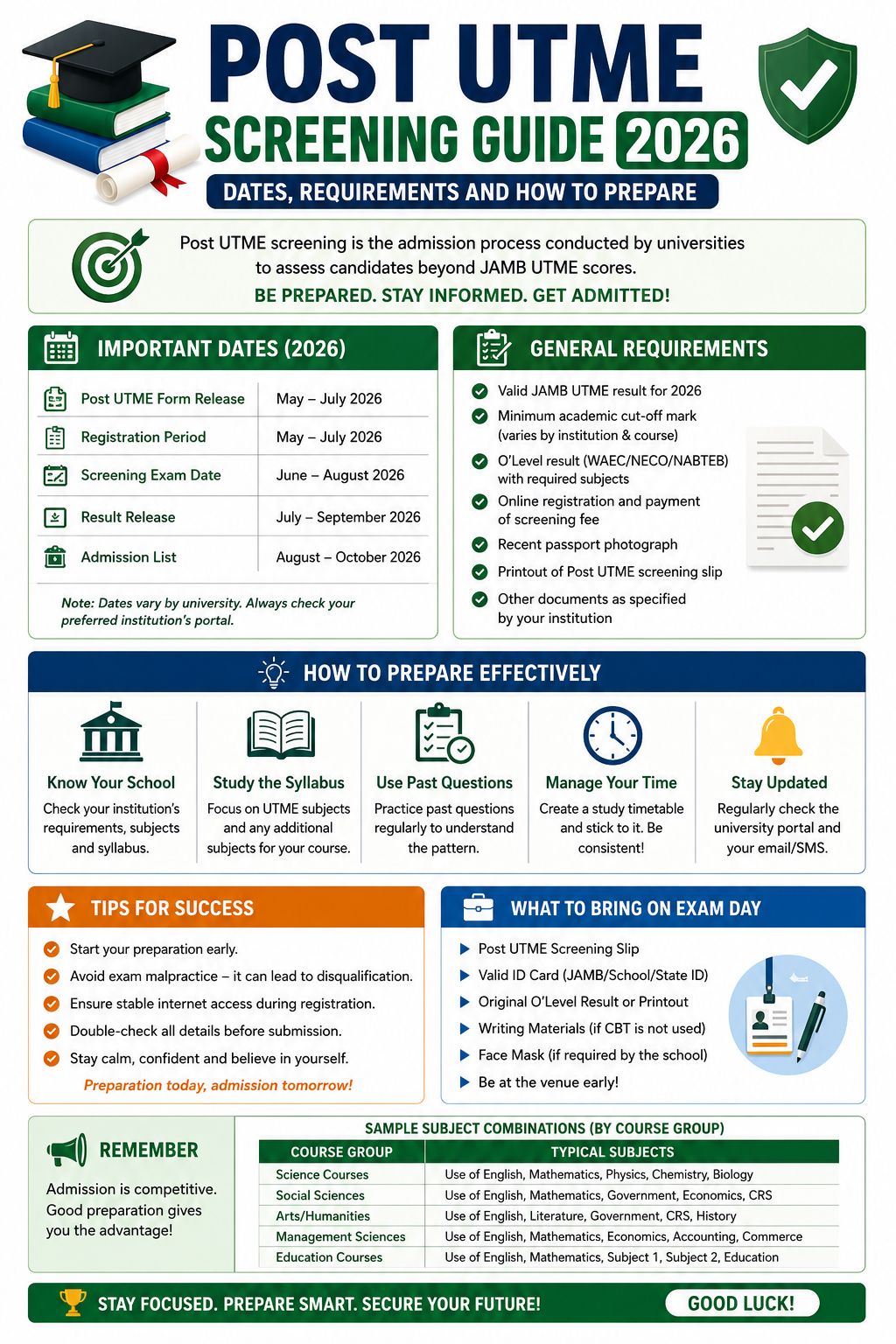
Post UTME Screening Guide 2026 — Dates, Requirements and How to Prepare
Category: Education | Author: NaijaToday Desk | Published: Sat Jul 04 2026
A real, no-nonsense comparison of MTN, Airtel, Glo and 9mobile (T2 Mobile) data prices in 2026 — plus the "Awoof" codes networks don't advertise loudly.
Post UTME Screening Guide 2026 — Dates, Requirements and How to Prepare You passed JAMB. Now comes the part nobody warns you enough about. If you sat the 2026 UTME and scored 200 or above, you're not done yet — you're at the start of the second, arguably more decisive stage: Post UTME screening , run individually by each university. This is where a good JAMB score can still lose you admission if you underperform on screening day, and where a modest JAMB score can be rescued by a strong Post UTME performance. Right now, in the first half of the 2026/2027 admission cycle, multiple Nigerian universities have Post UTME registration open or closing soon — so this is genuinely the moment to act, not a "someday" task. What Post UTME Actually Is Post UTME is a second screening exercise conducted by individual universities after JAMB releases UTME results. It exists because JAMB scores alone don't give universities enough confidence to admit — especially for competitive courses like Medicine, Law, and Engineering, where thousands of applicants can share similar JAMB scores. Depending on the institution, Post UTME can take one of two forms: A written or CBT screening test — usually 40 60 multiple choice questions covering Use of English plus your relevant subject combination, drawn from the JAMB syllabus (this is what UNILAG uses, for example) Document only screening — no test at all, just verification of your credentials and O'Level results (used by some universities, including LASU and ABSU in past cycles) Always confirm which format your specific university uses — don't assume based on what a friend at a different school experienced. General Eligibility (Applies Almost Everywhere) You must have scored the university's minimum JAMB cut off — commonly 200 for most federal universities, though this varies The university must be your first choice on your JAMB form — most institutions do not screen second choice candidates, though a few open supplementary screening for unfilled slots later in the cycle At least five O'Level credit passes , including English Language, in no more than two sittings (WAEC, NECO, or NABTEB) Your O'Level subjects must match the NUC approved subject requirements for your chosen course How Your Final Aggregate Is Calculated Most Nigerian universities use a standard weighting formula: Aggregate = (JAMB Score ÷ 400 × 60) + (Post UTME Score ÷ 100 × 40) Worked example: a candidate with a JAMB score of 260 and a Post UTME score of 70 gets: (260/400 × 60) + (70/100 × 40) = 39 + 28 = 67 out of 100 This is why Post UTME performance genuinely matters — a strong Post UTME score can meaningfully lift a moderate JAMB score, and a weak one can sink a strong JAMB score. Competitive courses like Medicine, Law, and Pharmacy typically need an aggregate around 65 and above; less