Resident Doctors Give FG Final 4-Week Ultimatum — What It Means for Hospital Care in Nigeria
Category: Health | Author: NaijaToday Desk | Published: Tue Jun 30 2026
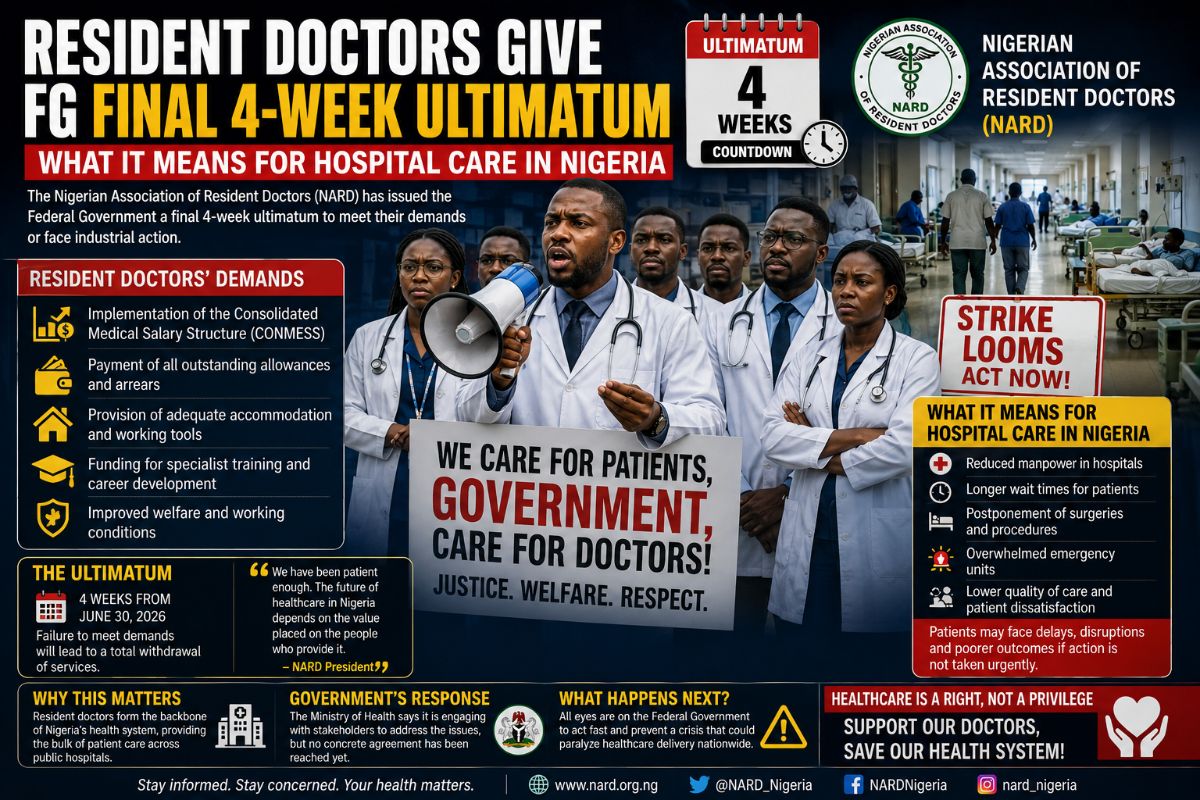
NARD has declared an official industrial dispute with the Federal Government and issued a final four-week ultimatum before a possible nationwide strike. Here's what's driving the crisis and what it means for patients.
Resident Doctors Give FG Final 4-Week Ultimatum — What It Means for Hospital Care in Nigeria Nigeria's public healthcare system is once again standing on the edge of disruption. The Nigerian Association of Resident Doctors (NARD) has formally declared an industrial dispute with the Federal Government and issued what it has described as a final four-week ultimatum, warning that it can no longer guarantee industrial harmony if its long-standing demands remain unmet. For the millions of Nigerians who depend on public hospitals and teaching hospitals for their healthcare, this is news that deserves close attention — not as a distant labour dispute, but as something that could directly affect access to care in the weeks ahead. How We Got Here This latest development did not come out of nowhere. The decision was reached during NARD's Extraordinary National Executive Council (E-NEC) meeting, held virtually on Saturday, June 27, 2026, after the association reviewed the Federal Government's response to an earlier 21-day ultimatum it had issued at its May 2026 Ordinary General Meeting. That earlier ultimatum expired without the government fully implementing its commitments, prompting this latest escalation. In a communiqué jointly signed by NARD President Dr. Mohammad Usman Suleiman, Secretary-General Dr. Shuaibu Ibrahim, and Publicity and Social Secretary Dr. Abdulmajid Yahya Ibrahim, the association confirmed it has now declared an official industrial dispute with the Federal Government — a formal escalation that sets the stage for the National Officers' Committee to begin all necessary preparations for industrial action should the government fail to demonstrate satisfactory compliance within the new deadline. This is a familiar pattern for anyone who has followed Nigeria's healthcare labour relations over the past few years. NARD declared a similar indefinite strike back in January 2026, citing the Federal Government's failure to implement a 19-point Memorandum of Understanding signed just two months earlier in November 2025, following a 29-day strike that had paralysed hospitals nationwide at that time. That January strike was suspended within 24 hours following high-level interventions, but with a two-week ultimatum attached even then. The cycle of strike threats, partial government concessions, and renewed grievances has repeated itself with troubling regularity throughout 2026. What Resident Doctors Are Actually Asking For At the top of NARD's list of grievances is the Federal Government's continued failure to release the 2026 Medical Residency Training Fund (MRTF), which the association says has remained unpaid despite repeated assurances from officials. This fund is critical because it directly supports the training and professional development of resident doctors — the backbone of Nigeria's teaching hospital workforce. Beyond the MRTF, NARD's core demands include the immediate payment of 19 months of outstanding professional allowance arrears, th