Japa or Stay? Making Sense of Nigeria's Career Crossroads in 2026
Category: Lifestyle | Author: NaijaToday Desk | Published: Fri Jul 10 2026
Every Nigerian family now seems to have at least one WhatsApp group chat dedicated entirely to "japa gist." You know the one. Someone shares a Canada Express Entry update, another person asks about UK skilled worker visa sponsorship for nurses, someone else drops a screenshot of a UCAS deadline, and somewhere in the middle of it all, an uncle who traveled in the 90s reminds everyone that "things were not this hard when I left o." I have that group chat too. Everyone does.
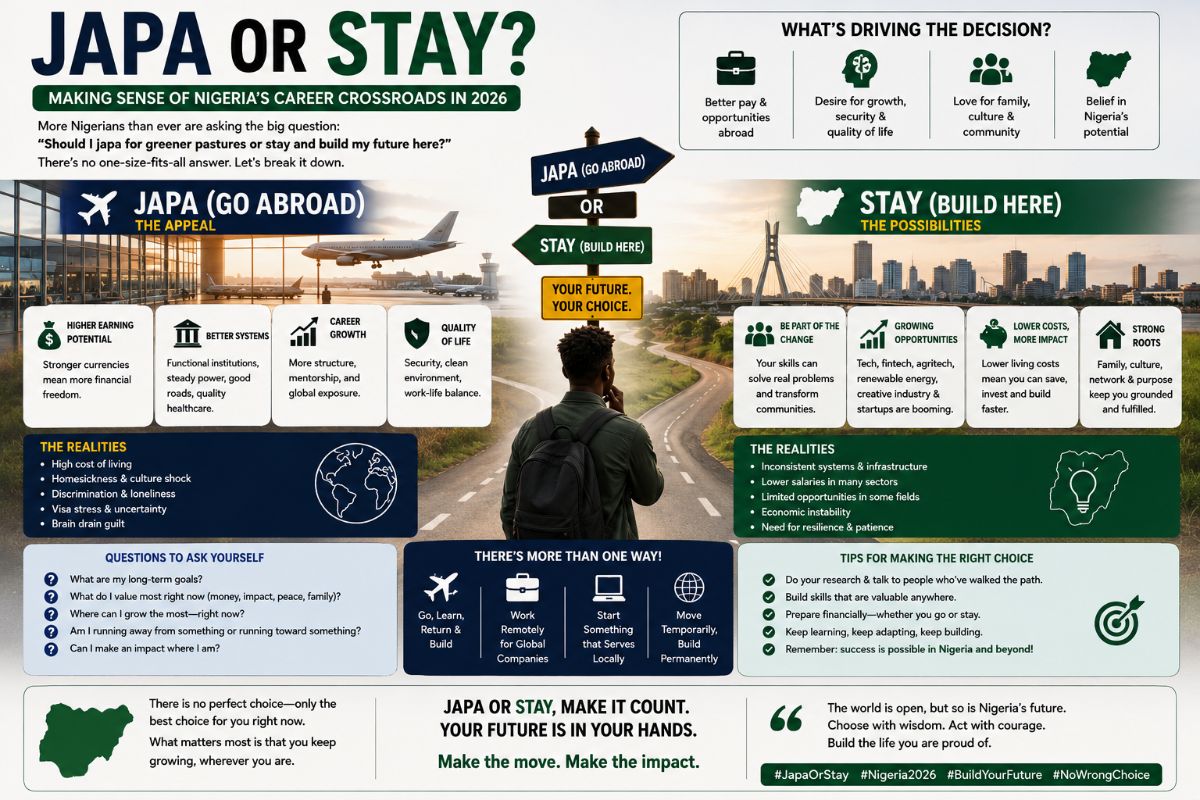
Japa or Stay? Making Sense of Nigeria's Career Crossroads in 2026 Every Nigerian family now seems to have at least one WhatsApp group chat dedicated entirely to "japa gist." You know the one. Someone shares a Canada Express Entry update, another person asks about UK skilled worker visa sponsorship for nurses, someone else drops a screenshot of a UCAS deadline, and somewhere in the middle of it all, an uncle who traveled in the 90s reminds everyone that "things were not this hard when I left o." I have that group chat too. Everyone does. But behind the memes and the group chat banter is a genuinely heavy decision that millions of young Nigerians are wrestling with right now, quietly, at 2am, staring at their phone: do I stay and try to build something here, or do I join the wave and leave? I don't think there's a single right answer, and I'm suspicious of anyone, on either side, who tells you there is. What I want to do instead is lay out what's actually driving this decision, what the data says, and what people who've made either choice have told me about how it's actually working out for them. Why the Question Even Exists Let's not pretend the japa conversation came from nowhere. It's rooted in real, measurable frustration. Depending on which unemployment figure you look at, and there's genuine controversy over how Nigeria calculates and reports this data, young people face a labour market that simply hasn't kept pace with population growth. Officially, the National Bureau of Statistics reported youth unemployment around 6.5 percent for those aged 15 to 24 using a revised methodology, but that number has been widely disputed by economists and ordinary Nigerians alike, since it counts anyone who worked even an hour in the reference period as "employed." Earlier figures using a different methodology put youth unemployment closer to 53 percent, a number that, frankly, matches what most of us see and feel on the ground far more than the newer figure does. Whatever the "correct" number is, the sentiment is unmistakable. A recent Afrobarometer survey found that an overwhelming 91 percent of young Nigerians believe the country is headed in the wrong direction, and when asked to rate government performance on job creation, the approval rating was a dismal 6 percent. When you combine that with inflation that's made saving nearly impossible for anyone earning in naira, and a cost of living that keeps climbing regardless of what your paycheck looks like, it becomes very easy to understand why "japa" stopped being a fringe idea and became a default life plan for so many young graduates. Academic research into what's actually driving this migration wave backs up the gut feeling. Studies looking at the "push factors" behind Nigerian emigration consistently point to youth unemployment, inflation, and weak government effectiveness as the strongest predictors, more significant even than instability or insecurity in some models. In plain English, people aren't pr