The Real Cost of "No Days Off": Rethinking Hustle Culture in Nigeria
Category: Lifestyle | Author: NaijaToday Desk | Published: Fri Jul 10 2026
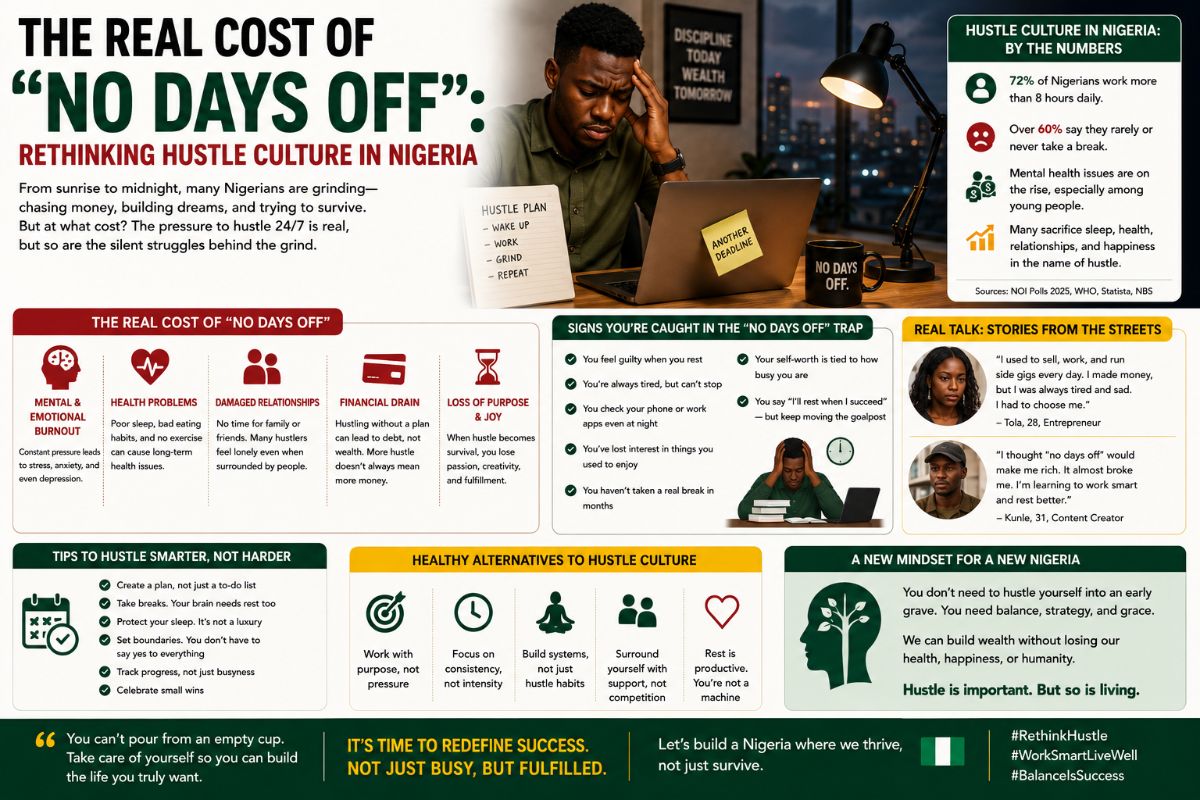
There's a phrase that's become almost a badge of honour among young, ambitious Nigerians: "grinding." You'll see it in Instagram captions at 5am gym check-ins, in LinkedIn posts about closing three side hustles before noon, in the way we casually ask each other "how many streams of income you get?" as though rest is a personal failure rather than a basic human need. I've said these things myself, honestly, more than once, and for a long time I believed them without question. It's only recently, watching friends burn out one after another, that I've started asking harder questions about what this culture is actually costing us.
The Real Cost of "No Days Off": Rethinking Hustle Culture in Nigeria There's a phrase that's become almost a badge of honour among young, ambitious Nigerians: "grinding." You'll see it in Instagram captions at 5am gym check-ins, in LinkedIn posts about closing three side hustles before noon, in the way we casually ask each other "how many streams of income you get?" as though rest is a personal failure rather than a basic human need. I've said these things myself, honestly, more than once, and for a long time I believed them without question. It's only recently, watching friends burn out one after another, that I've started asking harder questions about what this culture is actually costing us. Where This Comes From Let's be fair to ourselves first. Hustle culture in Nigeria didn't emerge from nowhere, and it isn't simply an imported American concept we absorbed through social media, though social media has certainly amplified it. It's rooted in a genuine, practical reality: for most Nigerians, there has never been a reliable social safety net. No meaningful unemployment benefits, limited public healthcare infrastructure, pensions that many people don't fully trust will be there when they retire, and a job market where a single income, even a "good" one, rarely stretches to cover rent, family obligations, and emergencies all at once. In that context, having multiple income streams isn't vanity, it's survival strategy. The civil servant who also drives for a ride-hailing app on weekends isn't chasing a trend, he's covering the gap between his salary and his actual cost of living. The young graduate juggling a day job with freelance graphic design at night isn't just "building her brand," she's often the primary or sole financial support for siblings still in school. I understand this deeply, and I don't want anything I say here to sound dismissive of that reality. But understanding where hustle culture comes from doesn't mean we should stop examining what it's doing to us, particularly as it's evolved from "doing what's necessary to survive" into something closer to an identity, a source of pride disconnected from whether the pace is actually sustainable. What I'm Actually Seeing I've watched this play out closely among people in my own circle, and the pattern is depressingly consistent. It usually starts with genuine ambition, someone taking on a second income stream because they need it or want to build toward something specific, a car, a wedding, capital for a bigger business idea. For a while, it works. There's energy, momentum, a sense of purpose in the grind. Then, gradually, the exhaustion creeps in. Sleep becomes the first casualty, five or six hours becomes the new normal, worn almost like a badge of discipline rather than acknowledged as a real health risk. Meals become irregular, breakfast skipped entirely most days, lunch eaten hurriedly at a desk or in traffic, dinner sometimes replaced with just tea and biscuits because cooking feels