The Secret World Beneath Our Feet: The Extraordinary Life of Ants
Category: Education | Author: By NaijaToday Science Desk | Nature & Wildlife | | Published: Tue Jun 16 2026
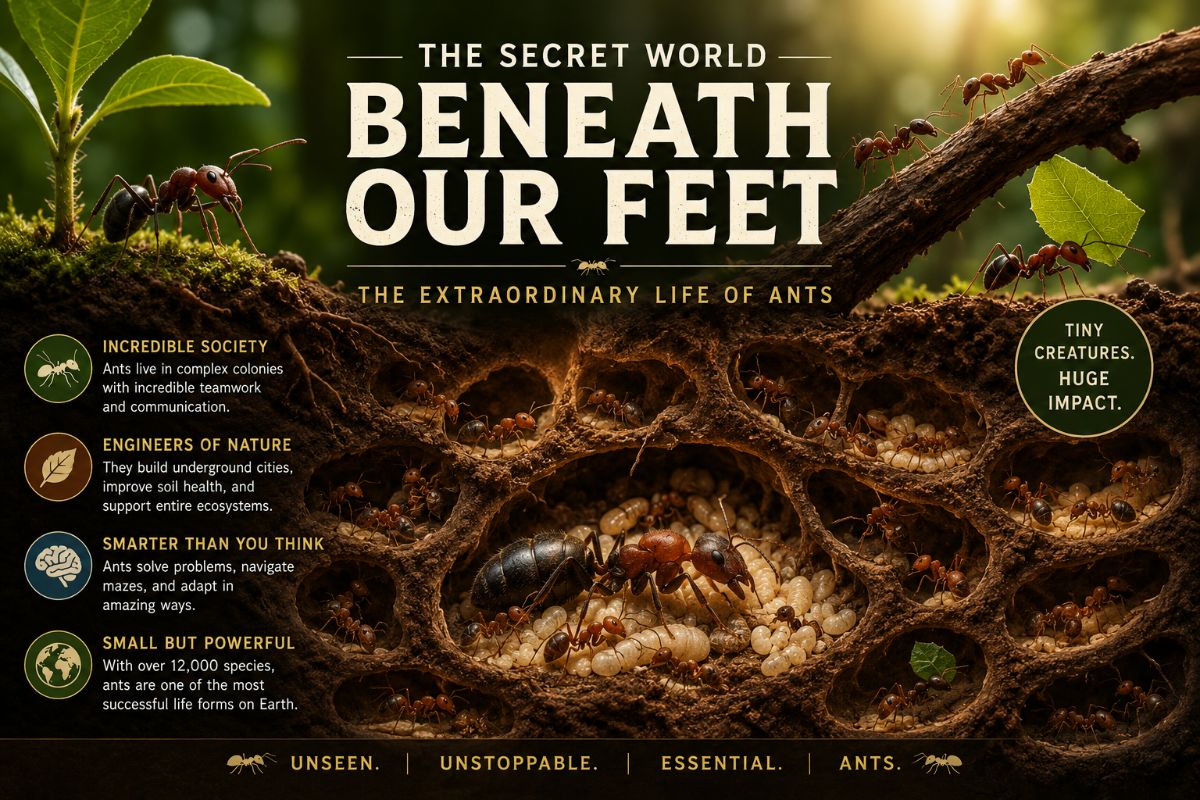
Every time you walk across a patch of red Nigerian soil — through a compound in Ibadan, along a dusty road in Kano, or beside a garden in Port Harcourt — you are stepping over one of the most sophisticated civilisations on Earth. Ants. Tiny, often ignored, occasionally cursed at when they invade the kitchen sugar. But beneath the surface of their small bodies and even smaller reputation lies a world of breathtaking complexity, ruthless efficiency, and biological wonder that puts many human institutions to shame
Every time you walk across a patch of red Nigerian soil — through a compound in Ibadan, along a dusty road in Kano, or beside a garden in Port Harcourt — you are stepping over one of the most sophisticated civilisations on Earth. Ants. Tiny, often ignored, occasionally cursed at when they invade the kitchen sugar. But beneath the surface of their small bodies and even smaller reputation lies a world of breathtaking complexity, ruthless efficiency, and biological wonder that puts many human institutions to shame. There are more than 20,000 known species of ants on the planet, and scientists believe thousands more are yet to be discovered. They have been walking this earth for over 140 million years — surviving the asteroid that wiped out the dinosaurs, outlasting empires, and colonising every continent except Antarctica. If you were to weigh every ant alive today, the combined mass would rival the total weight of all humanity. That is not a small thing. That is a force of nature in miniature. Born Into a Role: The Ant Caste System From the moment an ant egg hatches, its destiny is largely fixed. Ant colonies operate on a strict caste system — not decided by wealth or family name, but by biology and the needs of the colony at any given time. At the top sits the queen. She is the mother of the entire colony, sometimes living for 20 to 30 years — an extraordinary lifespan for an insect. Her sole purpose, once she has shed her wings after her mating flight, is to lay eggs. A mature queen of certain species can produce up to one million eggs in her lifetime. She does not govern in the way a human monarch might. She does not give orders. She simply reproduces, and in doing so, keeps the colony alive. Then come the workers — all of them female. These are the ants you see marching in lines across your floor or raiding a forgotten biscuit. Workers handle everything: foraging for food, nursing larvae, excavating tunnels, defending the nest, and even carrying out the dead. Different workers often specialise as they age. Younger ants tend to nurse eggs and larvae inside the nest, while older, more expendable ants venture outside to forage — a biological wisdom, since outside is where the dangers are. Male ants, interestingly, have the shortest and most singular life. Their only purpose is to mate with a young queen during the nuptial flight — the spectacular aerial mating event where winged queens and males swarm together in the sky. Once mating is complete, male ants die within days. They do not work. They do not fight. They exist solely to pass on genetic material and then expire. The Superorganism: One Colony, One Mind Perhaps the most remarkable thing about ants is that no single ant is truly running the show. There is no manager, no supervisor, no central brain issuing commands. And yet, an ant colony of half a million individuals operates with the kind of coordinated precision that any logistics company wo