10 Things Nigerians Do Abroad That They Would Never Do Back Home
Category: Lifestyle | Author: By NaijaToday Lifestyle Desk | Lifestyle | Published: Wed Jun 17 2026
here is a transformation that happens to Nigerians the moment the aircraft wheels lift off the tarmac at Murtala Muhammed International Airport. Something shifts. Behaviours that would have been unthinkable back home in Lagos, Abuja, or Enugu suddenly become not just possible but enthusiastically practised. The Nigerian who would never form an orderly queue at a bus stop in Ikeja becomes a fierce defender of queue integrity at a Sainsbury's checkout in London. The person who drove on the wrong side of the road in Lekki develops a sudden and passionate respect for traffic regulations in Toronto.
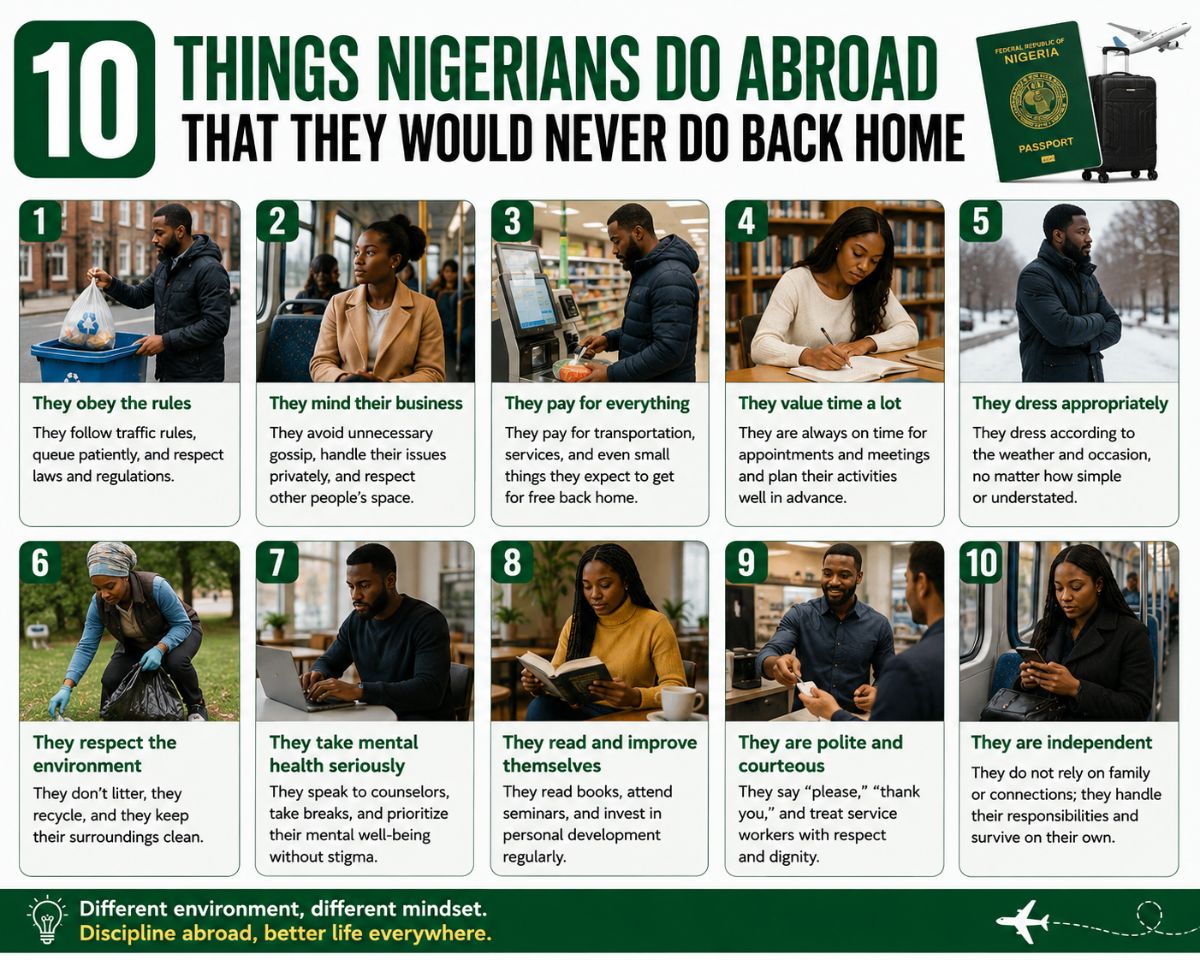
There is a transformation t hat happens to Nigerians the moment the aircraft wheels lift off the tarmac at Murtala Muhammed International Airport. Something shifts. Behaviours that would have been unthinkable back home in Lagos, Abuja, or Enugu suddenly become not just possible but enthusiastically practised. The Nigerian who would never form an orderly queue at a bus stop in Ikeja becomes a fierce defender of queue integrity at a Sainsbury's checkout in London. The person who drove on the wrong side of the road in Lekki develops a sudden and passionate respect for traffic regulations in Toronto. This is not hypocrisy — or at least, not only hypocrisy. It is a fascinating window into human behaviour, institutional trust, and the relationship between people and their environment. We behave differently when systems work, when rules are enforced, when the consequences of misbehaviour are real, and when the social culture around us sets a different standard. Here are ten things Nigerians do abroad that they would never do back home — observed with love, laughter, and a little bit of uncomfortable self-recognition. 1. Form a Queue and Defend It With Their Lives Back home in Nigeria, a queue is more of a suggestion than a structure. Bus stops, bank teller lines, government offices — in these spaces, the queue is a loose aggregation of bodies that is subject to negotiation, personal connection exploitation ("abeg, na my person"), and the simple physical principle that whoever pushes hardest gets served first. Abroad, the same Nigerian will stand in a queue for forty-five minutes without complaint, will shoot a withering glare at anyone who attempts to jump it, and will deliver a quiet but firm "excuse me, there's a queue" to offenders with the confidence of someone who grew up respecting lines their entire life. The queue is not the issue. The system that enforces the queue is the issue. When jumping a queue has real social and sometimes legal consequences, queueing becomes second nature remarkably quickly. 2. Separate Their Rubbish In Nigeria, the concept of separating waste into recyclables, general waste, and organic matter is not part of most households' daily practice. Rubbish goes into a bag. The bag goes — eventually — somewhere. The sorting is someone else's problem. Arrive in Germany, the Netherlands, or the UK, and that same Nigerian is diligently washing out yogurt pots before putting them in the recycling bin, carefully flattening cardboard boxes, and agonising over whether a greasy pizza box counts as card recycling or general waste. Not because their values about the environment changed on the flight — but because the system is clear, the bins are provided, the council collects them, and fines exist for those who do not comply. 3. Call the Emergency Services In Nigeria, calling the police is not instinctively the first response to an emergency for many citizens. Historical and ongoing issues with police conduct have created a culture in wh