From Lagos to Borno: Why Fuel Costs So Much More Up North
Category: Entertainment | Author: NaijaToday Desk | Published: Sat Jul 18 2026
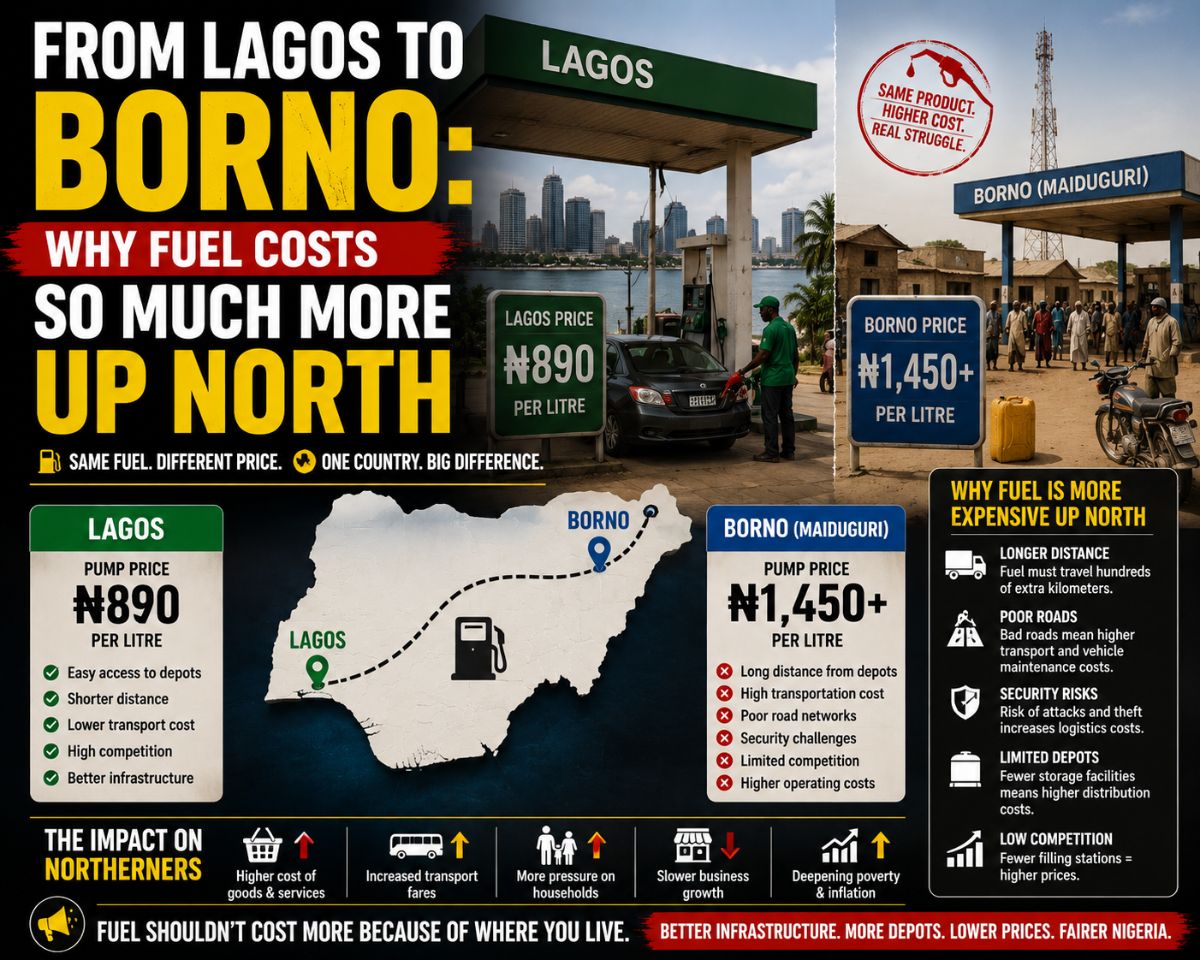
Breaking down why petrol prices differ by hundreds of naira between southern and northern Nigerian states, and what it costs traders and commuters in each region.
There is a joke that circulates among long-distance drivers in Nigeria, half bitter and half resigned: fuel doesn't get more expensive as you drive north, it gets heavier — heavier with diesel for the trucks that carried it there, heavier with the toll of bad roads, heavier with every checkpoint that slows a tanker down and adds another hour to a journey that eats into the margin a marketer can still call profit. It is, in its own way, an accurate description of how Nigeria's petrol market actually works three years after the 2023 removal of the fuel subsidy handed price-setting over to market forces. Officially, Premium Motor Spirit is a national commodity, priced by the same crude cost and the same naira exchange rate wherever you buy it. In practice, a litre of petrol in Lagos and a litre of petrol in Maiduguri are two very different purchases, separated by a gap that can run past ₦200 per litre depending on the week. Why Location Determines Price The mechanics are straightforward, if easy to forget when you're the one paying at the pump. Nigeria's major fuel supply points — the Dangote Refinery in Lekki, the NNPCL depots, and the tank farms clustered around Lagos and the Niger Delta — sit overwhelmingly in the south. States closer to refineries or major fuel depots like Lagos, Port Harcourt and Warri tend to have lower prices, while northern and remote states pay more due to logistics costs, since every litre sold in Kano or Maiduguri has already traveled hundreds of kilometers by tanker truck before it reaches a filling station, and every kilometer adds cost: fuel for the truck itself, driver allowances, tolls, and the informal costs of navigating a road network where potholes and, in parts of the Northeast, security concerns can add hours or days to a delivery. Among the ten states people most often ask about — Lagos, Rivers, Delta, Oyo, Anambra, Enugu, the FCT, Kano, Kaduna, and Borno — this logistics gradient plays out almost exactly as the map would predict. Lagos and Rivers, sitting closest to refining and import infrastructure, have consistently shown the lowest prices nationally, with Dangote-supplied stations in particular dipping toward ₦1,075 per litre in early July before the mid-month hike, and independent marketers in the ₦1,100 to ₦1,200 range. Delta, home to Warri's refining and depot infrastructure, sits close behind — cheap enough to benefit from proximity, but with slightly higher prices than Lagos in areas further from the depot clusters. Oyo, Anambra, and Enugu occupy the middle of the range. They're far enough from the major coastal depots that transport costs add a noticeable premium, but still connected by reasonably functional road networks that keep the gap from widening too far — typically landing somewhere in the ₦1,150 to ₦1,250 range depending on the specific filling station and week. Abuja (FCT), despite its status as the capital and its relatively good infrastructure, still sits a rung above the southern cities