The Owambe Economy: How Nigerian Parties Quietly Became Big Business
Category: Entertainment | Author: NaijaToday Desk | Published: Fri Jul 10 2026
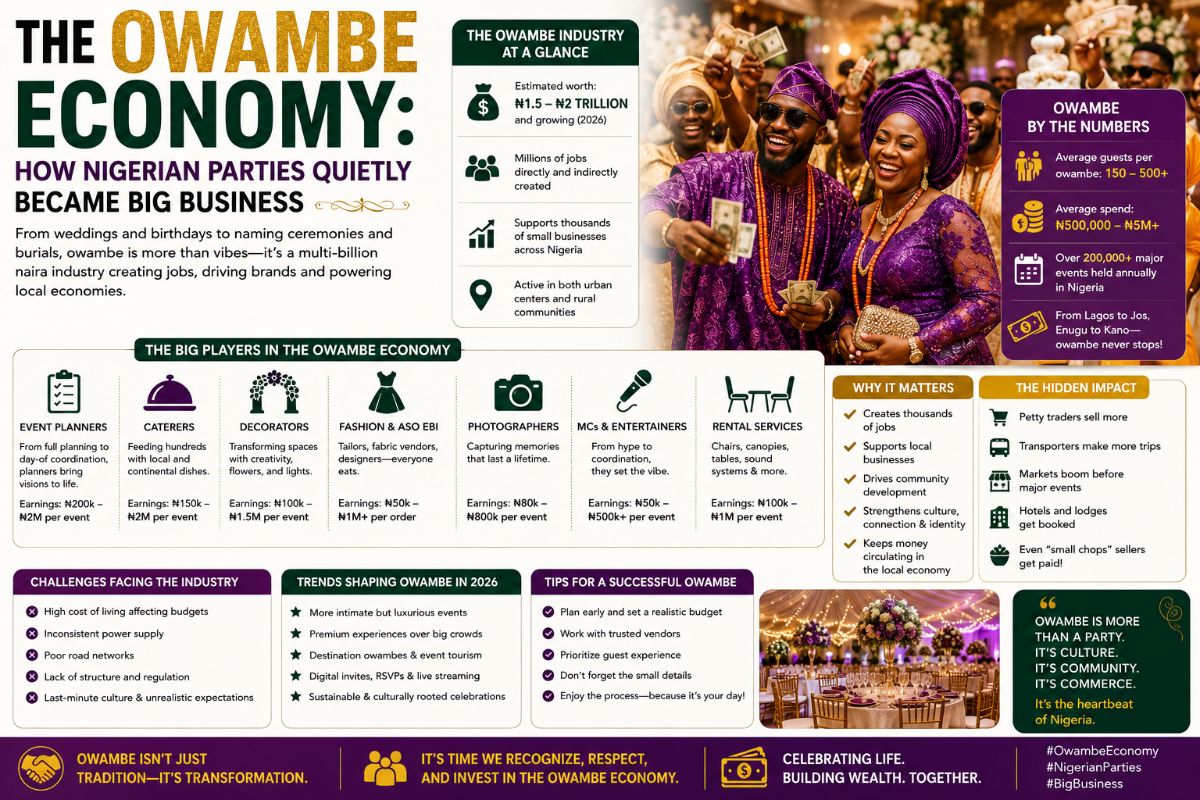
I attended a wedding in Ikeja a few months ago where the aso-ebi alone, the matching fabric guests are expected to buy and wear, cost more than what some entry-level graduates earn in a month. There was a live band, a DJ, a separate MC for the traditional engagement segment and another for the white wedding reception, a professional photography team with a drone, small chops stationed at three different corners of the hall, and a "surprise" celebrity performance that the couple had clearly budgeted for months in advance. By the time the day ended, I found myself doing quiet mental math and thinking, this isn't just a party anymore.
The Owambe Economy: How Nigerian Parties Quietly Became Big Business I attended a wedding in Ikeja a few months ago where the aso-ebi alone, the matching fabric guests are expected to buy and wear, cost more than what some entry-level graduates earn in a month. There was a live band, a DJ, a separate MC for the traditional engagement segment and another for the white wedding reception, a professional photography team with a drone, small chops stationed at three different corners of the hall, and a "surprise" celebrity performance that the couple had clearly budgeted for months in advance. By the time the day ended, I found myself doing quiet mental math and thinking, this isn't just a party anymore. This is an entire industry. If you're Nigerian, none of this will surprise you. Owambe culture, the elaborate, no-expense-spared approach to celebrating weddings, birthdays, burials, and pretty much any milestone worth marking, has always been part of who we are. What's changed, and what I think deserves more attention than it gets, is just how much of a legitimate economic engine this culture has quietly become, even as everyday Nigerians complain, rightly, about the cost of living. Why We Party Like This To understand the owambe economy, you first have to understand that for many Nigerians, these events were never just about celebration. They're about visibility, community, and status, wrapped into one loud, colourful, unforgettable day. Aso-ebi, the tradition of guests wearing matching fabric to show solidarity with the celebrant, isn't just fashion, it's a public declaration of relationship and support. Showing up "correctly dressed" at a friend's daughter's wedding says something about your standing in that friendship that words alone don't quite capture. There's also a deeply communal, almost redistributive logic to it that outsiders often miss. Money spent on a big wedding doesn't just disappear, it flows outward, to tailors, caterers, decorators, musicians, photographers, drivers, and dozens of other small vendors who depend on event season for a meaningful chunk of their annual income. In a country where formal employment is scarce and inconsistent, the owambe circuit has become a genuine, if informal, source of livelihood for an enormous number of skilled and semi-skilled workers. The Numbers Behind the Glitter Nobody tracks "owambe GDP" officially, there's no line item for it in any national budget, but if you talk to the people working inside this ecosystem, the scale becomes obvious fast. Aso-ebi fabric alone has become a multi-million naira micro-economy on its own. Popular Ankara and lace designs can sell for anywhere from ten thousand to well over a hundred thousand naira per yard depending on the quality and exclusivity, and a single wedding can move hundreds of yards when you factor in the bride's family, groom's family, and close friends all coordinating separate colours for different segments of the celebration. Multiply that acros