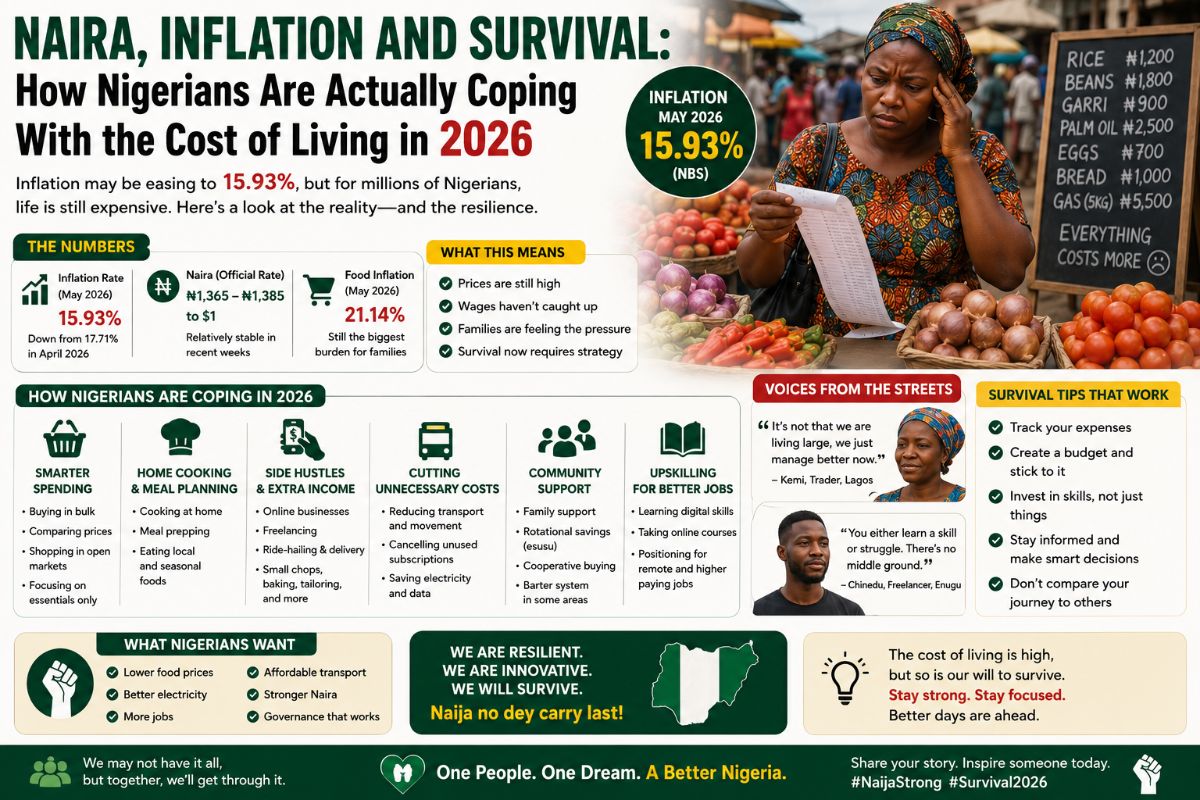
If you want to know how bad things really are in Nigeria, don't ask an economist. Ask any woman selling pepper and tomatoes at Mile 12 how much a basket costs her this week compared to last month, or ask a Lagos danfo conductor why he suddenly increased fare from Ojota to CMS by another hundred naira "because of fuel." The numbers from the National Bureau of Statistics will tell you inflation eased slightly and then crept back up again, month after month, hovering around 15 to 16 percent for most of this year. But numbers on a government website don't tell you what it actually feels like to walk into Shoprite with twenty thousand naira and leave with items that fit into one small nylon bag.
Naira, Inflation and Survival: How Nigerians Are Actually Coping With the Cost of Living in 2026 If you want to know how bad things really are in Nigeria, don't ask an economist. Ask any woman selling pepper and tomatoes at Mile 12 how much a basket costs her this week compared to last month, or ask a Lagos danfo conductor why he suddenly increased fare from Ojota to CMS by another hundred naira "because of fuel." The numbers from the National Bureau of Statistics will tell you inflation eased slightly and then crept back up again, month after month, hovering around 15 to 16 percent for most of this year. But numbers on a government website don't tell you what it actually feels like to walk into Shoprite with twenty thousand naira and leave with items that fit into one small nylon bag. I've spent the last few months talking to friends, family, market women, okada riders and even a few small business owners here in Lagos, trying to understand how the ordinary Nigerian is actually surviving this economy. Not the theory of it, not what the CBN governor says on television, but the actual, lived, day-to-day hustle of staying afloat when everything costs more than it did last year, and last year it already cost more than the year before that. The Numbers Behind the Struggle Let's start with what the data says, because context matters. Nigeria's headline inflation rose to 15.93 percent year-on-year as of May 2026, marking the third consecutive month of increase, after a period where things had actually started to ease from the brutal 30-plus percent rates we saw back in 2024. Food inflation alone sat close to 17 percent, which explains why every trip to the market feels like a small negotiation with your own budget. Core inflation, the figure that strips out food and energy to show underlying price pressure, nearly doubled month-on-month in May, which analysts say signals that price pressure is now spreading well beyond just food and fuel into almost everything else people buy. Meanwhile the naira has been doing its usual dance. Official market rates have hovered around ₦1,370 to the dollar in recent weeks, while the parallel market, the one most Nigerians actually deal with when sending money abroad or paying for imported goods, sits a bit higher. It's not the free fall we saw a couple of years back, and honestly there's been more stability lately than many of us expected, helped along by rising foreign reserves and steadier oil revenue. But stability at a high number is still a high number. A dollar that costs over a thousand naira means anything imported, from spare parts to skincare products to that phone you've been eyeing, remains expensive by any standard Nigerians were used to a decade ago. What People Are Actually Doing About It Here's where it gets interesting, and honestly, where Nigerian resilience shows itself in ways that no economic report can fully capture. Buying in bulk, together. I've noticed more people in my estate forming informal