Nigeria's Healthcare Crisis: Causes, Data & Solutions
Category: Health | Author: NaijaToday Desk | Published: Fri Aug 07 2026
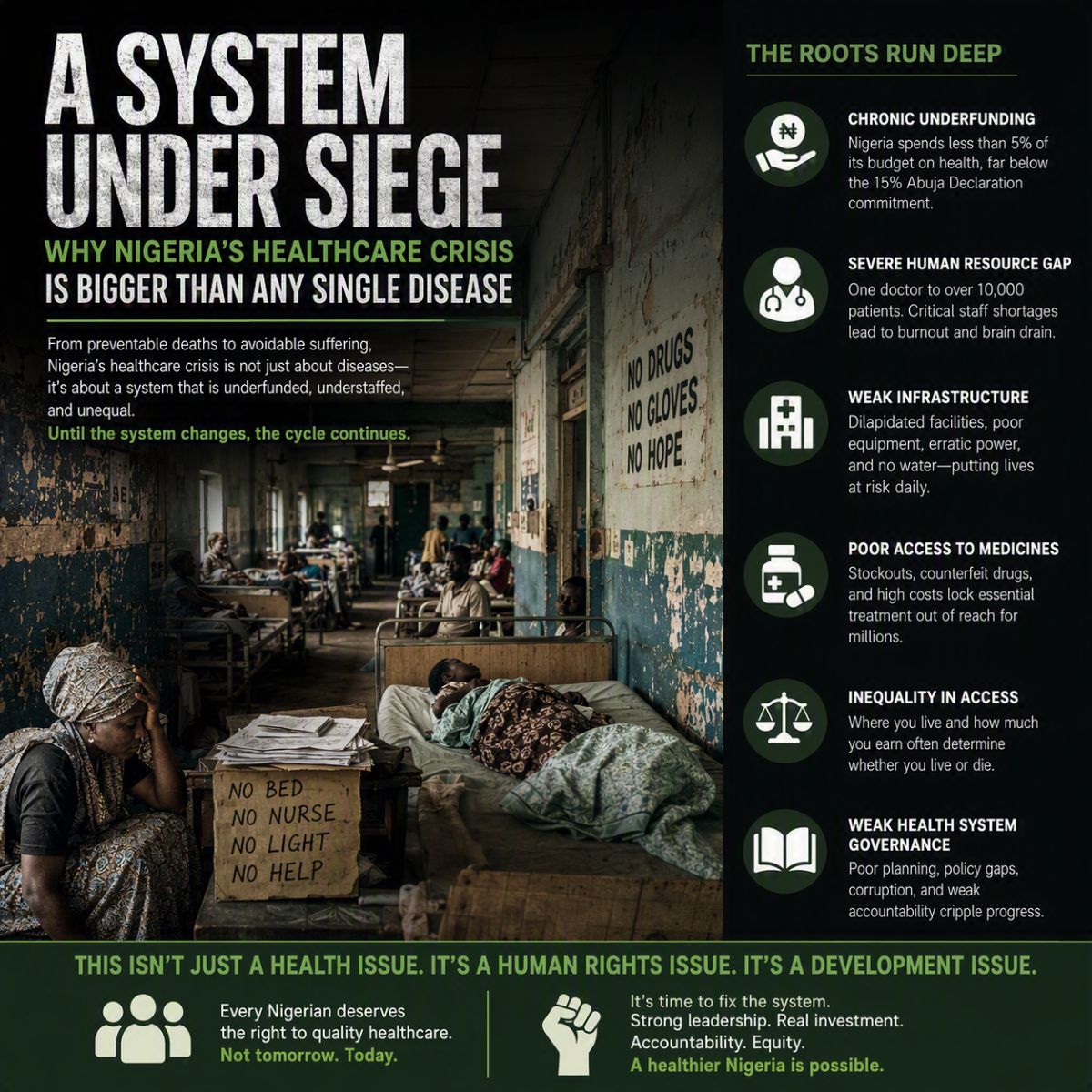
Why does Nigeria's health system keep failing its people? A deep look at maternal mortality, disease burden, funding gaps, and what could fix it.
A System Under Siege: Why Nigeria's Healthcare Crisis Is Bigger Than Any Single Disease A NaijaToday Feature Ask ten different Nigerians what's wrong with the country's healthcare system and you'll likely get ten different answers — no doctors, no drugs, no money, no ambulances, no time. All of them will be right, and none of them will be the whole story. Nigeria's health crisis isn't a single broken part waiting to be fixed. It's a system where every weakness feeds every other weakness, and where the people who pay the highest price — pregnant women in rural Sokoto, children under five in overcrowded clinics, families who simply can't reach a hospital in time — rarely make it into a budget speech. This is a look at what's actually happening inside that system, and why fixing it has proven so stubbornly difficult. The Number That Should Stop You Start with maternal mortality, because it's the single clearest window into everything else wrong with Nigerian healthcare. Depending on the state, a Nigerian woman's risk of dying from pregnancy-related causes ranges from roughly 512 to over 1,000 deaths per 100,000 live births. To put that in perspective: in the north-western states of Sokoto, Zamfara and Katsina, that figure exceeds 1,000 — meaning in some communities, one in every hundred pregnancies carries a real risk of ending in the mother's death. Southwestern states like Lagos and Oyo report meaningfully lower rates, though still far above what would be considered acceptable globally, revealing just how unevenly healthcare access is distributed across the country. What makes these numbers especially painful is how preventable most of the deaths are. Nationwide, malaria, obstructed labour, toxaemia and eclampsia, and unsafe abortion each account for roughly 11 percent of maternal deaths, according to a recent scoping review of maternal health data across Nigeria — conditions that, with functioning antenatal care and emergency obstetric services, are largely survivable. In a study of maternal deaths specifically in Ogun State, researchers found that only 51.1 percent of the women who died had attended antenatal care at all. The reasons were rarely about ignorance or neglect — many simply couldn't afford transport, couldn't take time off work, or lived too far from a facility that actually functioned. Health researchers studying the crisis have identified what they call the "three delays" that turn survivable emergencies into deaths: the delay in deciding to seek care, the delay in physically reaching a health facility, and the delay in receiving adequate treatment once a woman actually arrives. Each delay is driven by a different mix of poverty, geography, stigma and structural failure — which is exactly why no single intervention, however well-funded, fixes the problem on its own. As one maternal health advocacy group put it plainly: the tragedy isn't a lack of will. It's a lack of a system that meets that will halfway. When a primary health cent