The Real Reason Nigerians Can't Rest — And Why We Need to Learn How
Category: Lifestyle | Author: NaijaToday Desk | Published: Sun Jun 28 2026
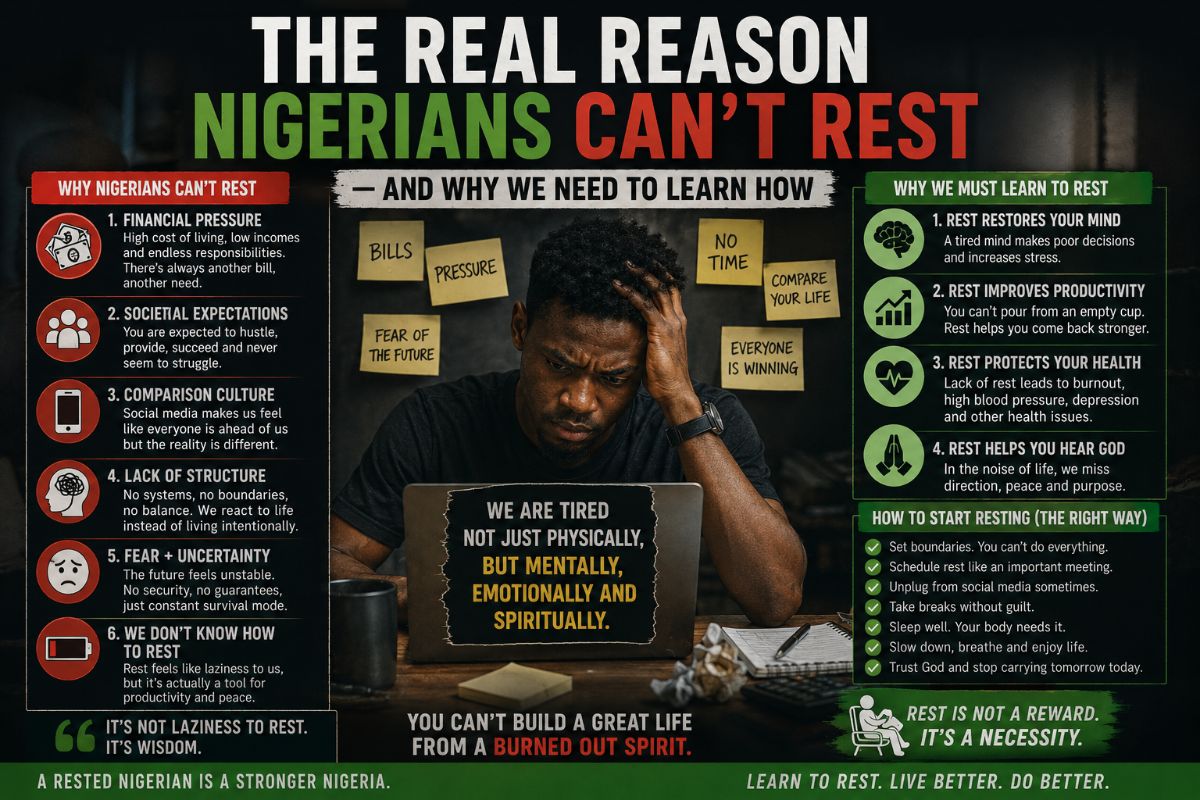
Hustle culture has taken over Nigerian life so completely that rest now feels like a sin. But what is the cost of a generation that doesn't know how to stop?
The Real Reason Nigerians Can't Rest — And Why We Need to Learn How On hustle, exhaustion, and the radical act of doing nothing Ask a Nigerian how they are doing and they will almost certainly tell you they are busy. Not fine. Not well. Not struggling — even if they are. Busy. Busy is the acceptable answer. Busy is the answer that signals that you are in motion, that you are not falling behind, that you have not yet been consumed by the circumstances that are consuming everyone around you. Busy is the armour that a particular kind of anxiety wears when it wants to look like ambition. Nigeria runs on hustle. It is practically in the water. From the hawker who is on the expressway before sunrise selling pure water through car windows to the tech bro in Yaba who is sleeping four hours a night trying to close a funding round to the market woman who leaves home in the dark and returns in the dark and does it again and again and again — the dominant mode of Nigerian life is movement. Forward, always forward, never stop, never slow down, because the moment you slow down, the country will pass you by and leave you behind and there is no safety net waiting to catch you when you fall. This is not melodrama. This is the lived reality of existing in a country where the systems that are supposed to support ordinary people — healthcare, education, pension, social welfare — are so dysfunctional that the only thing standing between most families and catastrophe is the individual's own relentless, exhausting effort. But here is the question that Nigerian hustle culture does not like to sit with: what happens to a person — to a generation — that never stops? What Hustle Culture Costs The body keeps score. This is not a metaphor. It is biology. Chronic stress — the kind that comes from years of financial precarity, from the daily negotiation of a city like Lagos, from the weight of being responsible not just for yourself but for parents and siblings and cousins and expectations that were placed on you before you were old enough to consent to them — does specific, measurable damage to the human body. It raises cortisol levels in ways that affect the heart. It disrupts sleep in ways that affect cognitive function and emotional regulation. It suppresses the immune system in ways that make the body vulnerable to illnesses it would otherwise fight off. It accelerates aging at a cellular level. None of this is visible. None of it shows up in the Instagram posts or the hustle content or the motivational captions that tell you to sleep less and work more and sacrifice everything now so you can rest later. But it is happening. In the bodies of young Nigerians who are pushing themselves past limits that were never designed to be pushed past. Who are treating rest as a reward to be earned rather than a biological necessity to be honoured. Who have internalised, somewhere deep and largely unconscious, the belief that their worth as human beings is directly proportional to thei